SCS or LBX selection route
Sanitary Pump Manufacturer for Food, Dairy & Pharma
A sanitary pump should be selected by product behaviour and process duty, not by the sanitary label alone. Shubham’s SCS centrifugal series is the starting route for compatible lower-viscosity hygienic liquids, while LBX lobe technology is reviewed for viscous, thick or shear-sensitive products after confirming the actual operating data.
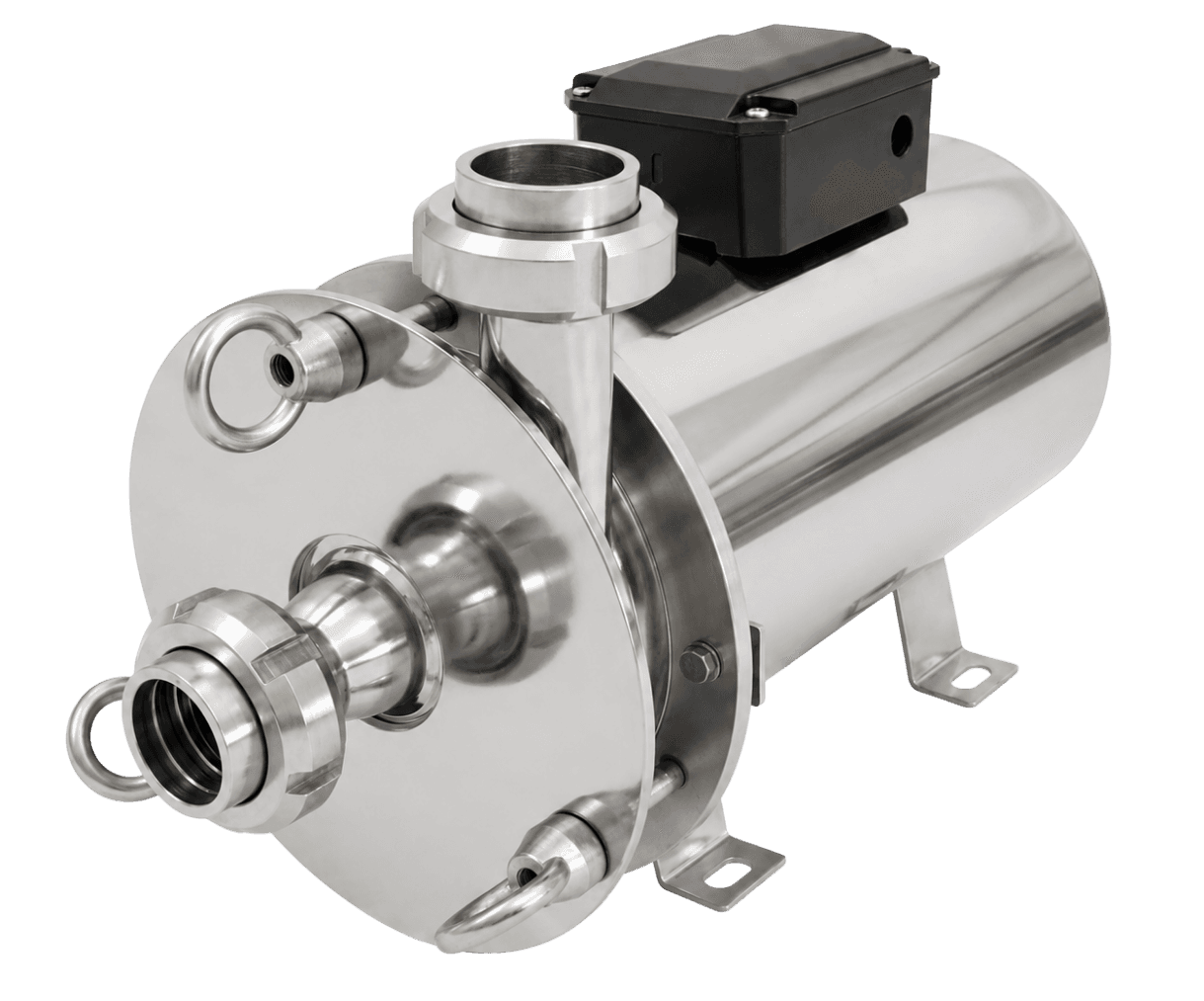
Application map
Start with the liquid, then choose the pump principle
This table is a screening guide. It does not replace duty-point selection or material and seal compatibility checks.
| Liquid / application | Typical process concern | Recommended starting point | Selection data needed |
|---|---|---|---|
| Milk and whey | Low viscosity, hygienic transfer and cleaning | SCS sanitary centrifugal | Confirm flow, total head, suction, temperature and connection. |
| Clear beverage or juice | Continuous transfer without damaging product quality | SCS where the duty is compatible | Check viscosity, solids, carbonation or foaming concern, and cleaning method. |
| Purified or clean process liquid | Material, connection and cleanliness requirement | SCS where centrifugal transfer fits | Confirm the required documentation and supplied configuration. |
| Cream or curd base | Viscosity, texture, solids and shear sensitivity | LBX rotary lobe | Confirm product condition at transfer temperature and required pressure. |
| Ghee | Viscosity changes with temperature and suction condition | LBX subject to duty review | Provide viscosity at operating temperature, line losses and cleaning method. |
| Thick syrup, sauce or paste | High viscosity, solids and controlled product handling | LBX rotary lobe | Confirm particle size, pressure, suction and seal compatibility. |
| Thin pharmaceutical process liquid | Clean transfer, MOC, seal and connection requirements | SCS after process review | Confirm liquid compatibility and documentation expectations. |
| Pharmaceutical or cosmetic cream, gel or paste | Viscosity, shear sensitivity and contamination control | LBX after material and seal review | Confirm cleaning, temperature, solids and the required supplied build. |
Technology comparison
SCS vs LBX for hygienic transfer
Review the sanitary centrifugal selection guide for the SCS route and the viscous food transfer guide for the LBX route.
| Factor | SCS | LBX |
|---|---|---|
| Pump principle | Centrifugal | Positive displacement rotary lobe |
| Starting viscosity route | Relatively low-viscosity hygienic liquids | Viscous, thick or paste-like products |
| Shear-sensitive duty | Review carefully before selection | Preferred starting route when product structure is sensitive |
| Solids | Confirm solids before using a centrifugal pump | Review particle size, concentration and rotor clearance |
| Flow behaviour | Flow varies with the system head and pump curve | Displacement-based flow; speed and pressure must be sized together |
| Sanitary connections | Select the supplied SCS connection for the process line | Select the supplied LBX connection for product and cleaning needs |
| Cleaning | Confirm the SCS build against the planned cleaning cycle | Verified LBX data lists easy-clean CIP or rapid manual cleaning |
| Typical starting applications | Milk, whey, beverage and compatible clean liquid transfer | Cream, ghee, yogurt or curd base, thick syrup, sauce and paste |
| Critical selection inputs | Flow, total head, suction, viscosity, temperature and MOC | Viscosity, flow, pressure, suction, temperature, solids and seal |
Selection workflow
What a purchase or engineering team should establish first
- 01
Classify the product
Record viscosity at the real transfer temperature, solids and shear sensitivity.
- 02
Define the operating point
Provide flow together with total head or discharge pressure and the suction condition.
- 03
Define hygienic interfaces
Confirm cleaning method, connection, MOC, seal and elastomer requirements.
- 04
Review the series
Compare the suitable SCS or LBX configuration before requesting a quotation.
| Review area | Information to provide | Why it matters |
|---|---|---|
| Liquid behaviour | Name, composition, pH and specific gravity where relevant | Establishes compatibility and hydraulic assumptions. |
| Product consistency | Viscosity at operating temperature, solids and particle size | Separates centrifugal duties from lobe-pump duties. |
| Required duty | Flow plus total head or discharge pressure | Allows an actual model and drive to be sized. |
| Suction | Tank level, flooded or lift condition, pipe size and line length | Helps assess filling, cavitation risk and inlet losses. |
| Hygiene | Cleaning method, cleaning liquid, connection and drainage expectation | Defines the configuration that must fit the process. |
| Compatibility | MOC, seal, elastomer and temperature requirements | Prevents product-contact and sealing mismatch. |
| Supply | Motor, drive, electrical requirement, installation format and quantity | Defines the complete quotation scope. |
Thin-liquid route
Inspect SCS for sanitary centrifugal transfer
Use the official SCS product page for verified configurations and specifications. The dairy selection guide explains why milk and whey normally begin with the centrifugal route.
Viscous-product route
Inspect LBX for thick or sensitive products
Use the official LBX product page for verified construction and selection data. Buyers with a defined dairy duty can continue to the cream transfer or ghee transfer review.
Other defined duties include cosmetic cream texture, gel behaviour and pharmaceutical paste documentation.
For a personal-care filling line, the shampoo formulation review adds foam, texture and changeover requirements to the LBX duty.
Selection support
Send the product and duty data before choosing a sanitary pump
Include liquid name, viscosity at operating temperature, flow, head or pressure, suction condition, solids, cleaning method, connection, material, seal, motor requirement and quantity. Shubham Industries can then review the appropriate SCS or LBX route.
Common questions
Sanitary pump selection questions
What is a sanitary pump?
A sanitary pump transfers product-contact liquids where cleanability, wetted material, connection, seal and process hygiene matter. The label alone does not select the pump principle. Flow, head or pressure, viscosity, temperature, solids, shear sensitivity and cleaning method must still be reviewed.
Should I choose a sanitary centrifugal pump or a lobe pump?
Start with SCS for compatible lower-viscosity hygienic liquids that suit centrifugal transfer. Start with LBX when the product is viscous, paste-like, higher in solids or sensitive to shear. Final selection depends on the complete duty rather than the industry name.
Which Shubham pump is normally reviewed for milk transfer?
SCS is the normal starting point for low-viscosity milk and whey transfer when flow, head, suction, temperature, material, connection and cleaning requirements match the available configuration.
Which pump is normally reviewed for cream or ghee?
LBX is the normal starting point because cream and ghee duties can be viscosity-sensitive and may need positive displacement transfer. Cream texture and ghee viscosity at the actual operating temperature must be confirmed before sizing.
Can the same hygienic pump handle both thin and thick products?
Do not assume one pump is suitable for every product on a line. A centrifugal pump selected for a thin liquid may be unsuitable for a thick or shear-sensitive product. Review the most demanding product and each cleaning cycle before choosing a shared pump.
What information is required to select a sanitary pump?
Share the liquid name, viscosity at operating temperature, flow, total head or discharge pressure, suction condition, specific gravity, pH where relevant, solids, cleaning method, connection, seal and elastomer compatibility, MOC, motor requirement and quantity.