SCS buyer guidance
Sanitary Centrifugal Pump Manufacturer
A sanitary centrifugal pump is used for compatible lower-viscosity hygienic liquids when centrifugal flow suits the process. Shubham’s SCS Series is the starting product for milk, whey, beverage, purified water and clean process duties, provided the required flow, total head, suction, material, connection, seal and cleaning conditions are confirmed.
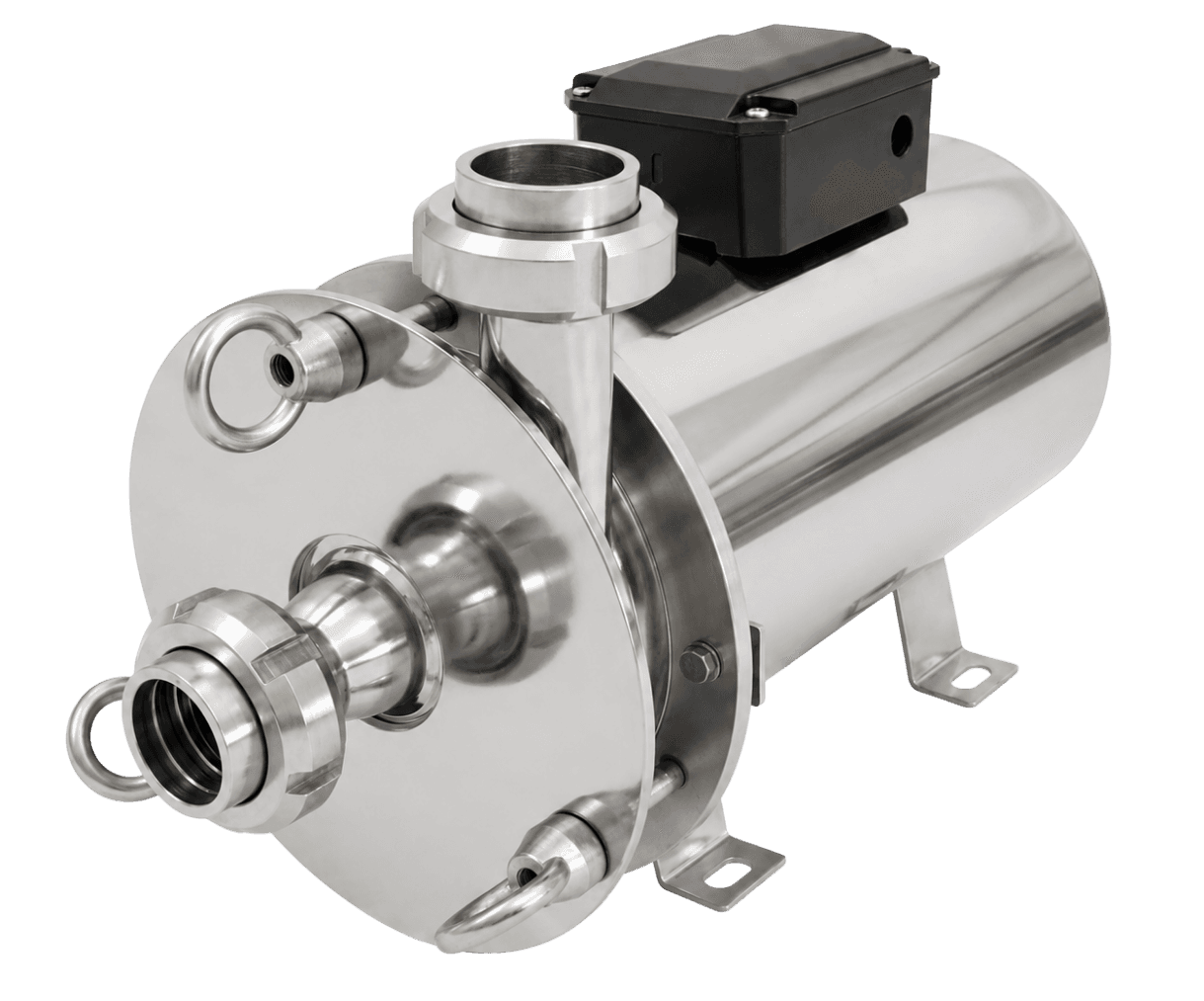
Centrifugal principle
Use the operating point, not the pump name alone
SCS selection begins by plotting the required flow against total head. The liquid properties and suction arrangement then determine whether that point is practical. A sanitary connection or stainless material does not correct an unsuitable hydraulic selection.
Flow
State the required transfer rate, including any minimum and maximum operating condition.
Total head
Combine static lift, pipe friction, fittings and process back pressure.
Suction
Describe the source tank level, inlet pipe and whether suction is flooded.
Liquid
Provide viscosity and temperature together because consistency can change with temperature.
Liquid review
Where sanitary centrifugal selection normally begins
The dairy pump guide provides the broader dairy decision. These rows focus specifically on duties that may fit centrifugal transfer.
For fruit processing, the clear juice and pulp review explains when a juice recipe needs more than a centrifugal starting check.
| Liquid | Main concern | SCS starting position | Data to confirm |
|---|---|---|---|
| Milk | Relatively low viscosity and hygienic transfer | Suitable starting application in verified SCS data | Flow, total head, temperature, suction and cleaning method |
| Whey | Clean transfer and stable duty point | Suitable starting application in verified SCS data | Flow, total head, product condition, connection and MOC |
| Low-viscosity buttermilk | Thickness and solids can vary | Review SCS only when the actual consistency fits | Viscosity, solids, temperature, flow and head |
| Fruit juice or beverage base | Viscosity, pulp, foam and cleaning | SCS candidate where solids and product behaviour permit | Composition, solids, flow, head, cleaning and connection |
| RO, DM or purified water | Clean transfer and material requirement | Listed within SCS process applications | Required water quality, MOC, seal, flow and head |
| Thin pharmaceutical process liquid | Compatibility, hygiene and documentation | Review SCS after process requirements are defined | Liquid name, temperature, MOC, seal, connection and cleaning |
Duty-point worksheet
Information needed before an SCS model can be selected
| Selection input | What to provide | Engineering reason |
|---|---|---|
| Required flow | Normal, minimum and maximum operating flow where relevant | Establishes the capacity point used to shortlist a model. |
| Total head | Static lift, elevation, line friction, fittings and back pressure | Defines the resistance the pump must overcome at the required flow. |
| Suction condition | Flooded suction, tank level, inlet line and any lift | Helps review inlet losses and the risk of poor filling or cavitation. |
| Liquid properties | Viscosity, specific gravity, temperature, pH and solids | Changes hydraulic performance and material or seal suitability. |
| Process interfaces | Connection standard, line size and cleaning arrangement | Ensures the supplied pump fits the hygienic process line. |
| Product-contact materials | Required MOC, seal and elastomer compatibility | Must suit both the product and the cleaning chemistry. |
| Drive and installation | Motor supply, mounting format, area requirement and quantity | Completes the pump-set and quotation scope. |
Selection boundary
When sanitary centrifugal technology may not be suitable
These conditions trigger a new technology review. For thick or product-sensitive duties, compare the food-grade lobe pump selection route and the verified LBX product data.
| Condition | Why it changes the decision | Next review |
|---|---|---|
| High viscosity | Centrifugal efficiency and suction performance may become unsuitable | Review LBX or another positive displacement series. |
| Shear-sensitive texture | Impeller action may not suit a product whose structure must be preserved | Review LBX with the product behaviour documented. |
| Large or fragile solids | Solids may obstruct or be damaged by the selected hydraulic passage | Provide particle size and concentration for an alternate-series review. |
| Self-priming requirement | SCS should not be assumed to self-prime | Review the suction arrangement or a verified self-priming series. |
| Unknown cleaning or compatibility requirement | A sanitary label does not confirm every cleaning cycle or material | Define chemistry, temperature, seal, elastomer and MOC before selection. |
For a broad SCS-versus-LBX comparison, return to the sanitary pump technology guide. The official SCS page remains the source for series specifications and configuration choices.
Selection support
Send flow and total head together for SCS selection
Include the liquid, viscosity, temperature, specific gravity, solids, suction condition, connection, cleaning method, MOC, seal, motor requirement and quantity so the sanitary centrifugal duty can be reviewed as a complete operating point.
Common questions
Sanitary centrifugal pump questions
When is a sanitary centrifugal pump normally appropriate?
It is normally considered for compatible lower-viscosity hygienic liquids that can be transferred efficiently by centrifugal action. The required flow, total head, suction condition, temperature, material, connection, seal and cleaning method must all fit the selected configuration.
Can SCS be reviewed for milk and whey transfer?
Yes. Milk and whey are listed in the verified SCS application data. Final selection still requires the actual flow, total head, suction condition, temperature, cleaning method, connection and product-contact material requirement.
Why must flow and head be supplied together?
A centrifugal pump operates on a performance curve. Flow without total head does not define the duty point, and head without the required flow is also incomplete. Pipe losses, elevation and process back pressure must be included in the total head calculation.
Which sanitary connections are listed for SCS?
Verified SCS data lists tri-clover, SMS, flanged and threaded connection options. The selected connection must match the process line, cleaning method and supplied pump configuration.
When should LBX be reviewed instead of SCS?
Review LBX when viscosity, solids, paste-like consistency or shear sensitivity makes centrifugal transfer unsuitable. Thick cream, ghee, yogurt or curd base, sauce and paste duties normally need a positive displacement review.