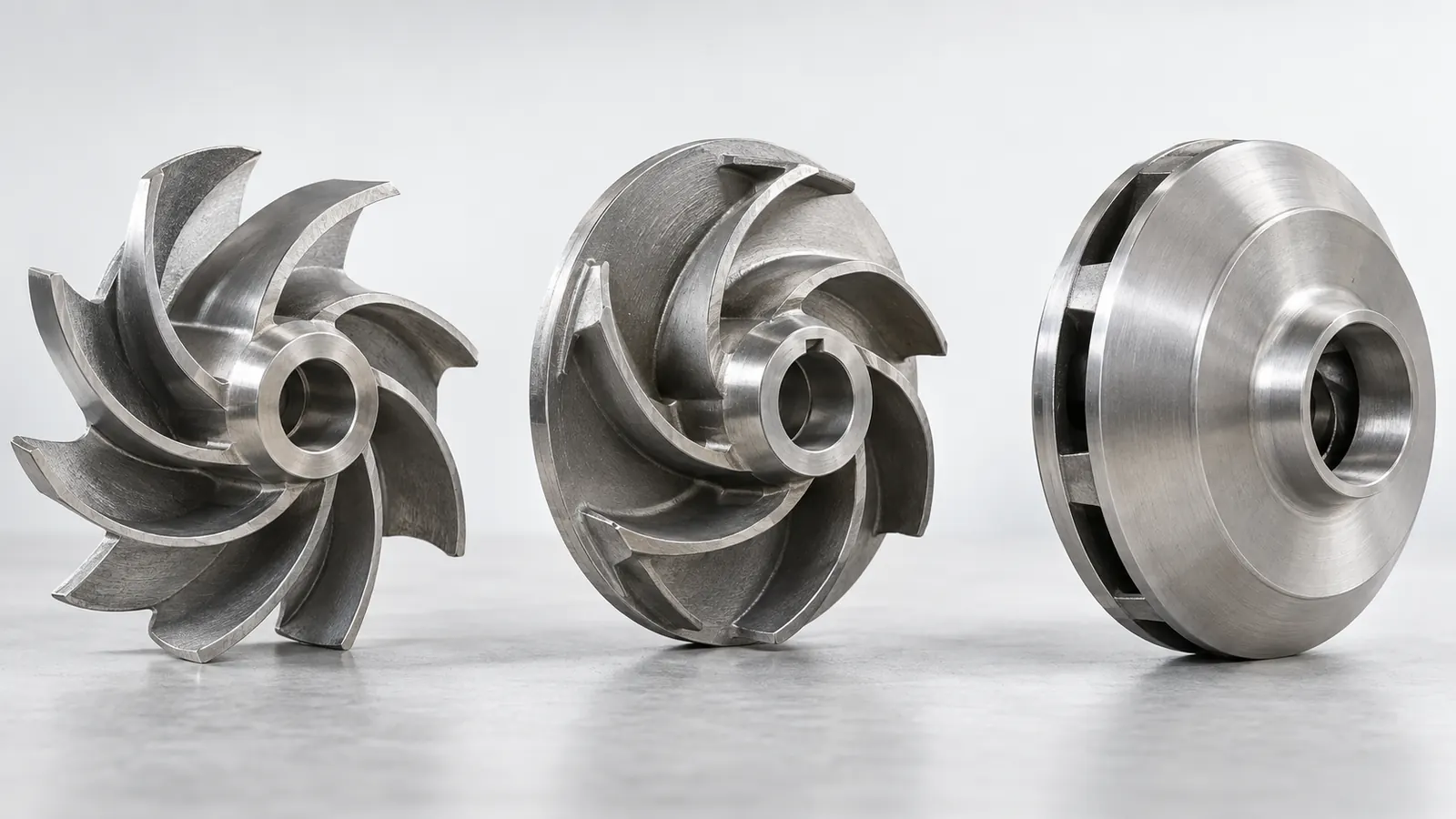
Open, semi-open and closed impellers differ in how their vanes are enclosed by shrouds. That geometry affects internal leakage, clearance sensitivity, cleaning access and the type of liquid a pump can handle. The correct choice still depends on actual solids, duty point and the manufacturer's model design; impeller labels alone do not establish performance.
Read the geometry before choosing the pump
An open impeller has exposed vanes. A semi-open impeller has one shroud; a closed impeller has a front and rear shroud enclosing the flow passages. These descriptions identify construction, not a guaranteed solids size, efficiency or maintenance interval. Enclosing vane passages can reduce some internal leakage compared with an exposed-vane arrangement, but actual efficiency must be read from the selected model curve. Passage shape, casing clearances, materials and operating point also matter.
Open impellers: access and clearance matter
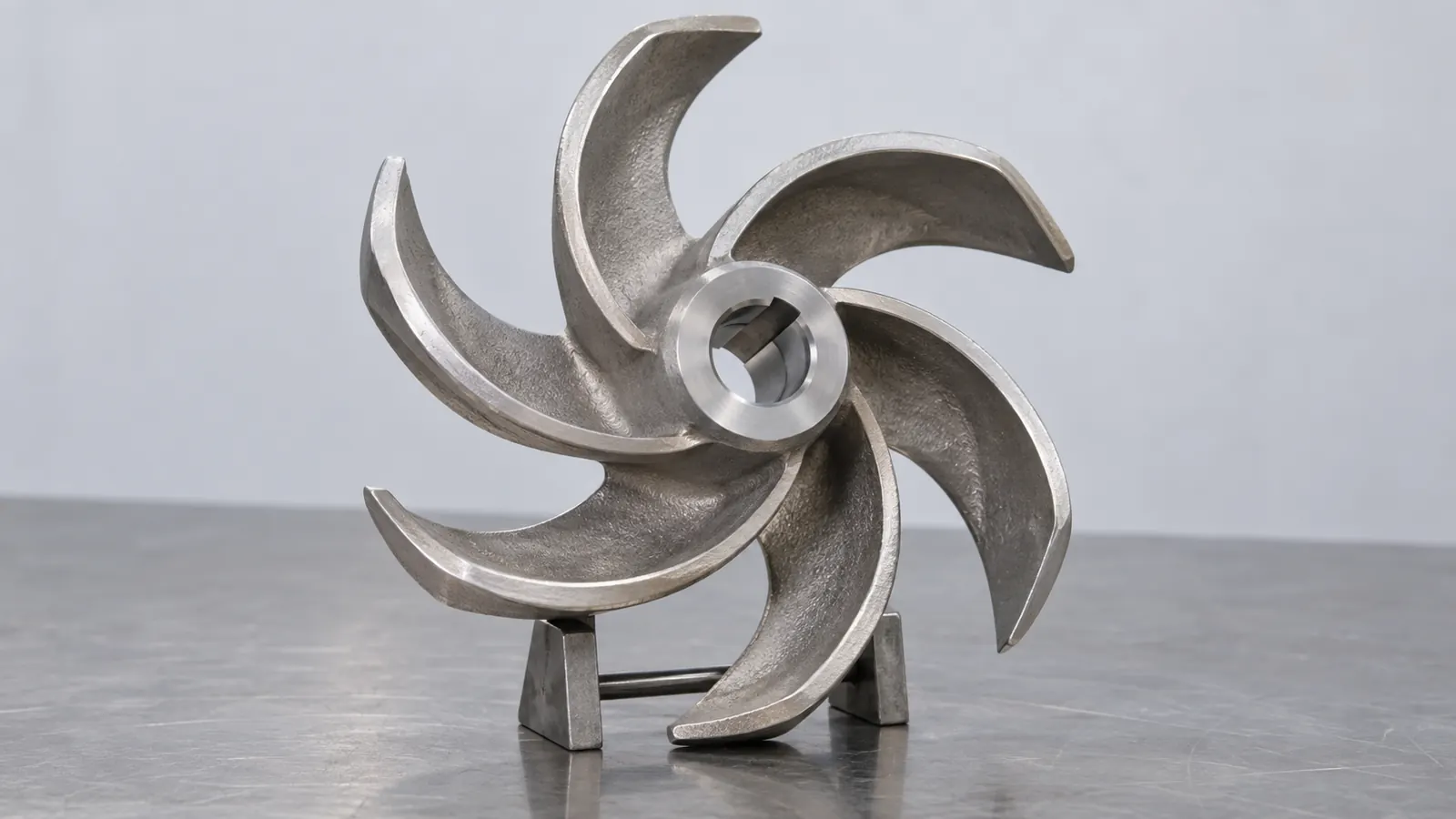
The exposed-vane arrangement can give access for inspection and can be considered where the model is designed for liquids containing some solids. Performance depends strongly on vane-to-casing clearance and wear. An exposed passage can be easier to inspect for lodged material, but it is incorrect to assume every open impeller is non-clogging or suitable for any particle.
Semi-open impellers: a model-specific middle ground
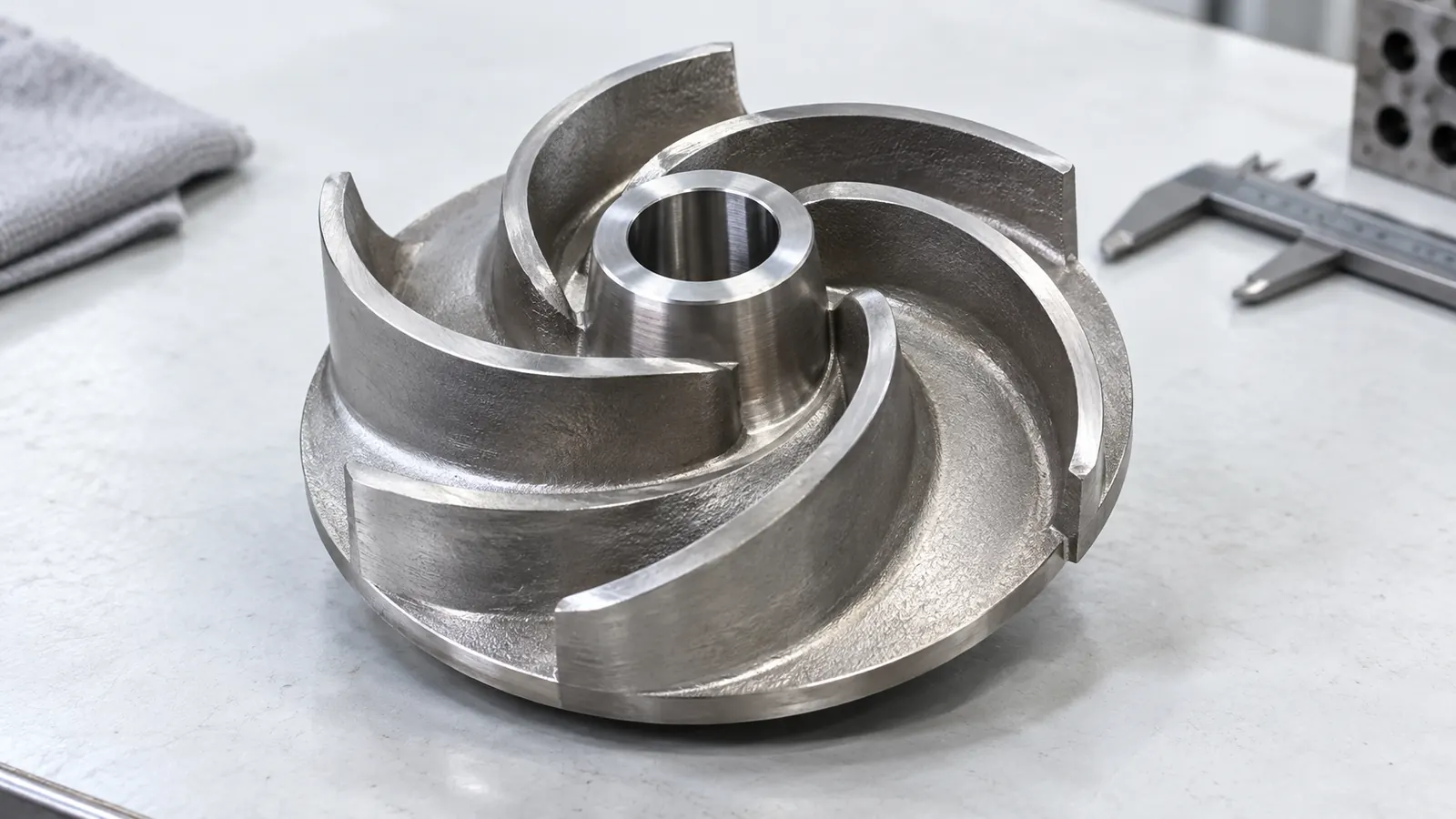
One shroud leaves one vane side exposed. Selection still requires the expected solids, clearance adjustment provisions and a manufacturer curve for the actual model. Shubham's SCC data lists a closed impeller as standard and a semi-open option on request; availability should be confirmed for the duty and configuration.
Closed impellers: enclosed passages for appropriate liquids
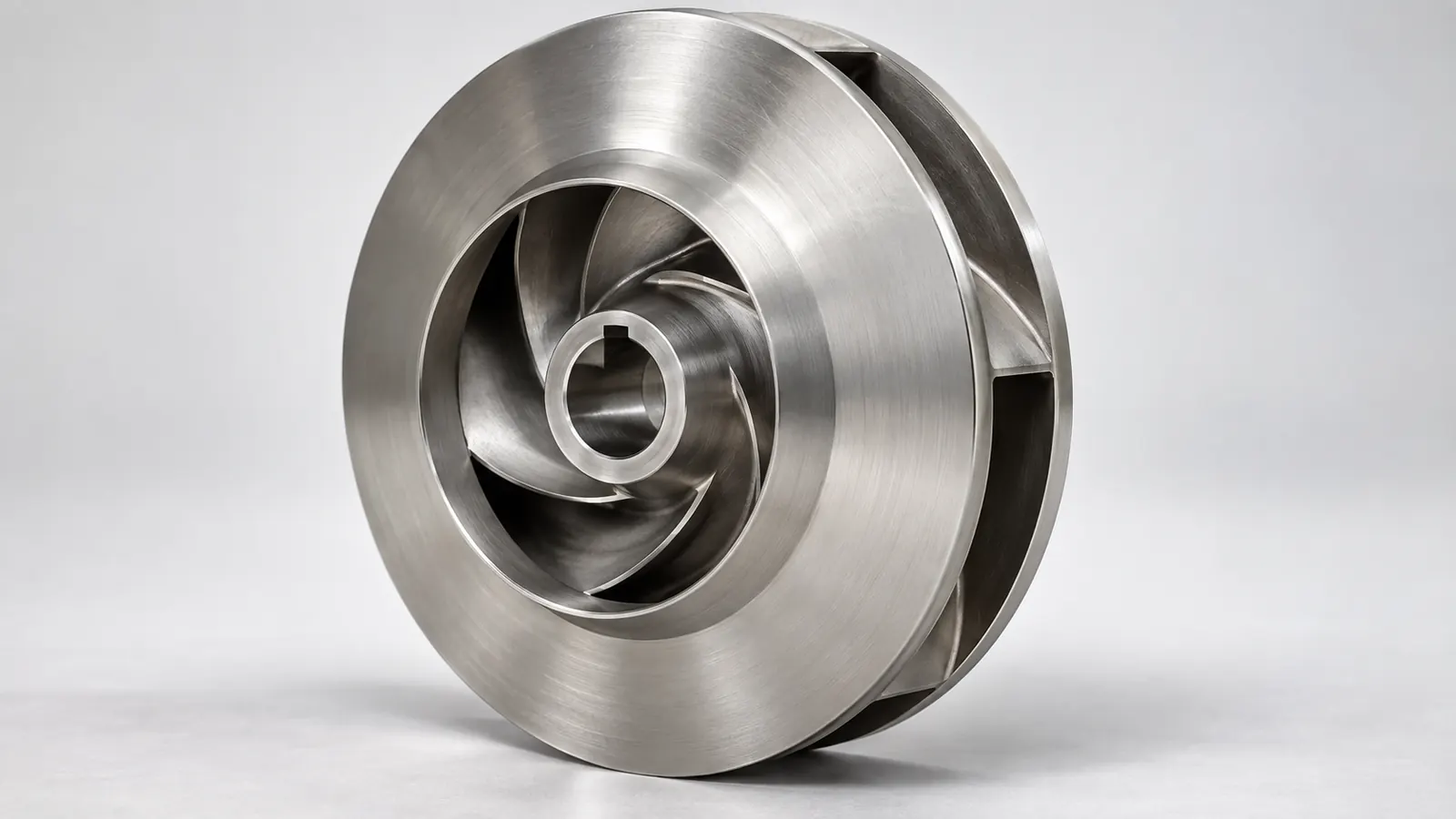
The enclosed passage arrangement is commonly evaluated for cleaner liquids when hydraulic performance is the priority. Passage width and inlet geometry still determine whether a particular model can pass a given solid. A closed passage can clog when unsuitable solids enter it. Wear at internal running clearances can change performance over time, so selection and maintenance should use the actual model documentation.
What to send for final selection
Provide the liquid, solids character and concentration, required flow and head, suction condition, temperature and cleaning/maintenance constraints. Ask for the actual pump curve and impeller configuration rather than selecting by a generic impeller drawing. Compare service access and expected wear points with the process duty.
Impeller selection considerations
| Aspect | Open | Semi-open | Closed |
|---|---|---|---|
| Shrouds | Vanes exposed | One side enclosed | Both sides enclosed |
| Liquid screening | Review solids and possible buildup | Review solids and clearance | Review clean-liquid suitability and passage size |
| Wear focus | Vane-to-casing clearance | Open-side clearance | Internal running clearances |
| Maintenance question | How is clearance inspected? | Can clearance be adjusted? | How are enclosed passages inspected? |
| Final evidence | Model-specific curve and solids review | Model option and duty confirmation | Model curve and passage review |
Related guidance and engineering review
Use the relevant product and technical guidance below to check the actual duty. For a model-specific review, send the liquid, flow, head or discharge pressure, suction conditions, temperature, and available pump and motor records through the technical inquiry form.
- SCC series details — Check the verified standard and optional impeller configuration.
- SPM series — Review another repo-documented impeller design.
- CMB series — Consider the documented clean-liquid application without assuming its impeller construction.
- pump performance curves — Compare hydraulic duty using model data.
Frequently asked questions
What is the main difference between open and closed impellers?
An open impeller has exposed vanes; a closed impeller encloses the vane passages between shrouds. The full pump design determines application suitability.
Is a semi-open impeller available in the Shubham SCC series?
Shubham's SCC product data lists a closed impeller as standard and a semi-open impeller on request. Confirm the option for the specified duty.
Which impeller handles solids best?
There is no universal answer from the label alone. Particle size, concentration, passage geometry and the specific pump model govern the decision.
Does a closed impeller always have higher efficiency?
Geometry can influence hydraulic losses, but an efficiency claim requires comparison of actual curves at the duty point, including wear and operating conditions.
What maintenance issue differs between these designs?
Clearance and passage access differ. Ask how the selected model is inspected, adjusted and cleaned for the expected liquid.
—— GET EXPERT HELP
Need a model-specific engineering review?
Share the operating conditions and current observations. Our team can review the pump and installation duty.