Last Updated: June 2026 - Verified by Shubham Industries Engineering Team
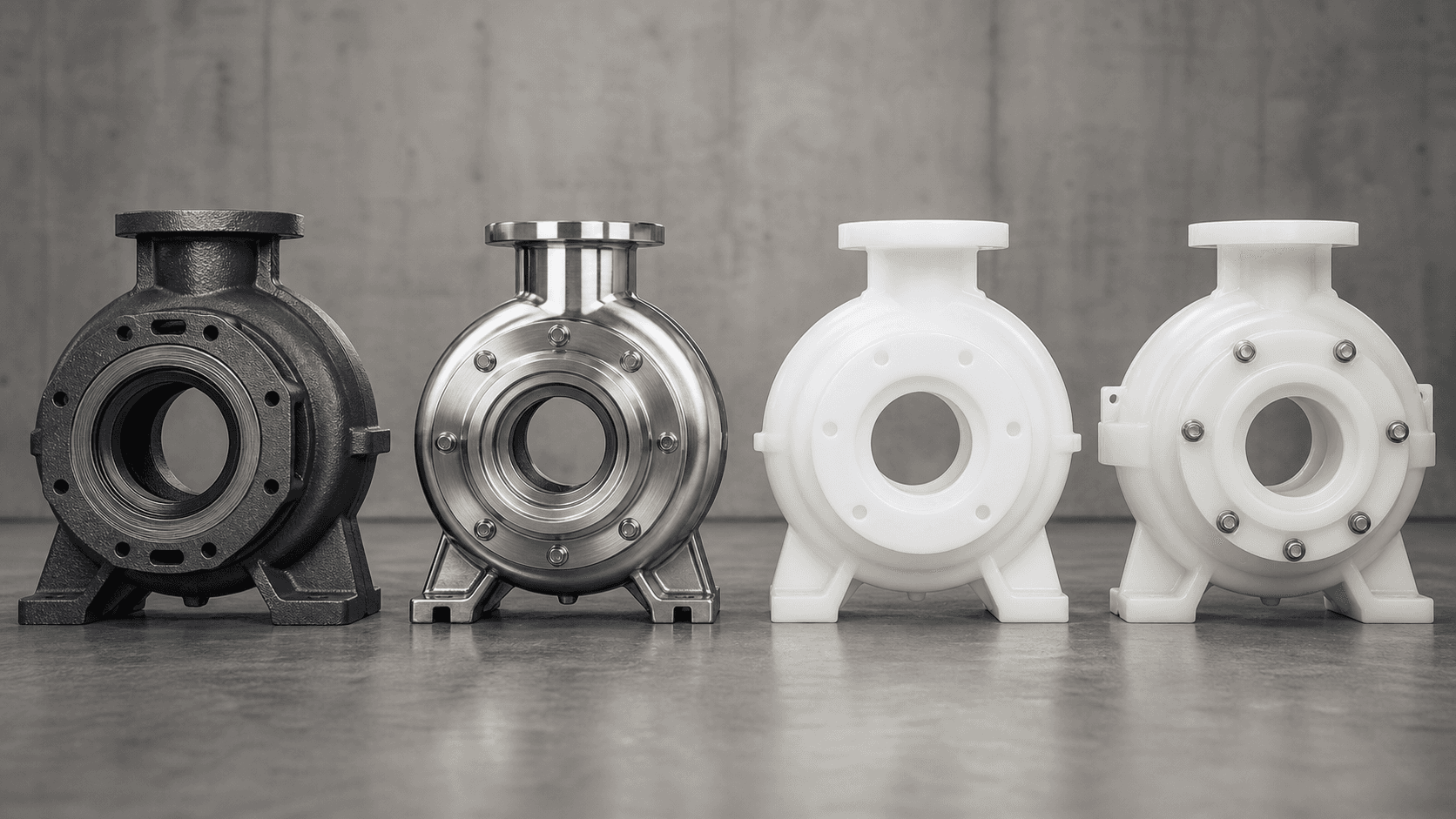
MOC, or Material of Construction, is the single most important technical specification in industrial pump selection after pump type. Specify the wrong MOC and the pump can fail from corrosion, contamination, or structural damage even when the hydraulics are correctly sized.
At Shubham Industries, Ahmedabad's industrial pump manufacturer since 1987, MOC selection is the first engineering decision for every application. The correct MOC requires matching chemical aggressiveness, operating temperature, pH range, and whether food or pharmaceutical purity standards apply.
This guide covers Cast Iron for water and neutral fluids, SS304 and SS316 for process chemicals, SS316L for food and pharmaceutical, Polypropylene for strong acids and alkalis, and PVDF for high-temperature aggressive chemicals.
Defining MOC: Wetted vs Non-Wetted Parts
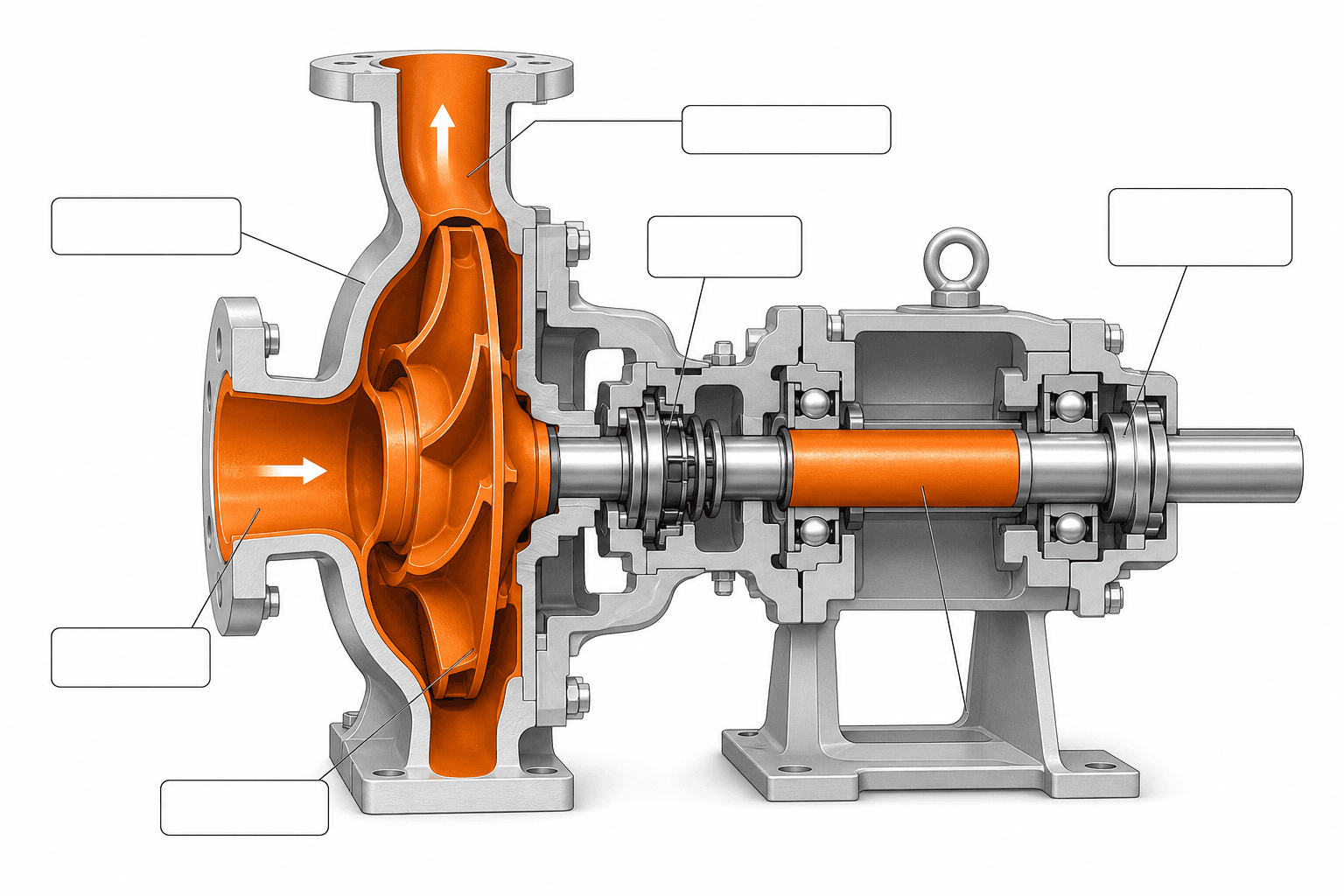
MOC in pump engineering refers specifically to the materials used for components that contact the pumped fluid. These are called wetted parts. Non-wetted components such as motor, bearing housing, coupling, and base frame use standard engineering materials because they do not touch the liquid.
Wetted parts include impeller, pump casing, shaft sleeve, mechanical seal faces, gaskets, O-rings, and back plate. Each must be compatible with the fluid. In corrosive service, the weakest wetted material determines the effective chemical resistance of the whole pump.
A pump with SS316 casing and impeller but Buna-N O-rings can fail rapidly in acetone service because acetone attacks NBR elastomers. The metal was correct; the elastomer was the weak link. This is why Shubham Industries specifies casing, impeller, shaft sleeve, seal faces, and elastomers before confirming compatibility.
Common Metallic MOCs: Cast Iron, Bronze, SS304, SS316
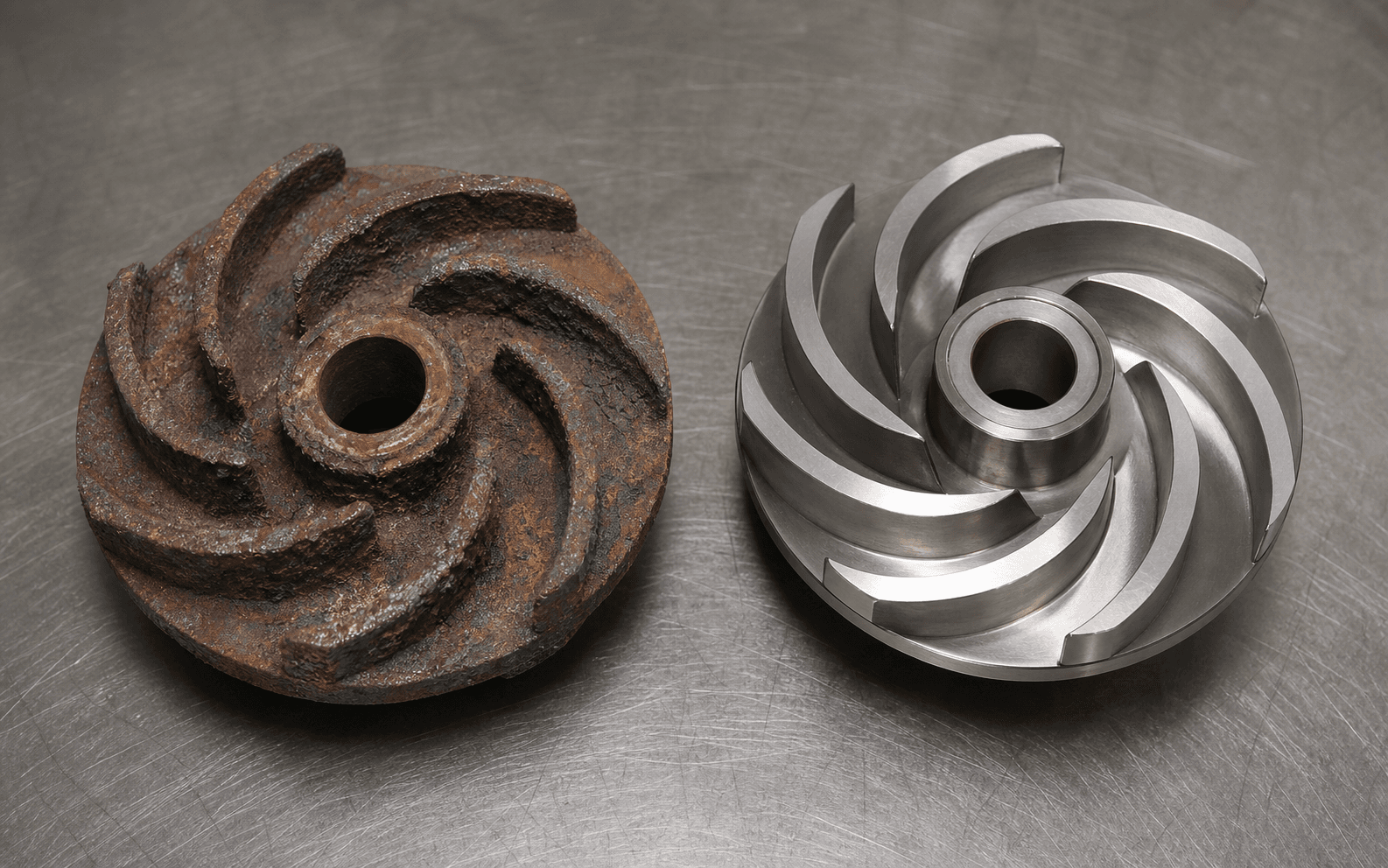
Cast Iron is the lowest cost pump material and works well for water, cooling water, and neutral process fluids with pH 6-9. It should not be used for acid, alkali, or corrosive chemical service. Bronze is used in some seawater and cooling water duties where pressure and chemical exposure are moderate.
SS304 contains chromium and nickel for general corrosion resistance. It is suitable for mild process duties and food-contact water service but lacks molybdenum, so it is vulnerable in chloride environments. SS316 adds molybdenum, improving resistance to pitting and chloride corrosion in recommended service conditions.
Important limitation: SS316 is not suitable for hydrochloric acid, hydrofluoric acid, or high-chloride environments that can trigger stress corrosion cracking. If selecting an SCC Series stainless steel centrifugal pump, always verify chloride concentration and temperature before final grade selection.
-- QUICK ANSWER
What does MOC mean in industrial pumps?
MOC stands for Material of Construction, the engineering specification that defines what materials are used for every pump component that contacts the pumped fluid. These components are the wetted parts: impeller, pump casing, shaft sleeve, mechanical seal faces, gaskets, and O-rings. Selecting the correct MOC is critical because an incorrect material can cause corrosion failure, product contamination, or structural damage even when pump hydraulics are correct. Common MOCs in Indian industrial pump applications are Cast Iron for neutral water service, SS304 for mild process duties, SS316 for general chemical service, SS316L for food and pharmaceutical, Polypropylene for acids and alkalis at suitable temperatures, and PVDF for more aggressive service. Shubham Industries specifies MOC for every wetted component before compatibility confirmation.
Shubham Industries | Kuha, Ahmedabad, Gujarat, India | Since 1987
Non-Metallic MOCs: PP, PVDF, and PTFE
For highly corrosive chemicals where SS316 is not suitable, thermoplastics and fluoropolymers provide the required resistance. Polypropylene is widely used for chemical pump construction and handles a broad pH range at ambient temperatures. The CPP Series is commonly evaluated for acid and alkali transfer duties after checking chemical name, concentration, and temperature.
PP is cost-effective but temperature-limited, typically around 60-70 deg C depending on duty. PVDF provides better temperature capability and stronger resistance to many aggressive chemicals, making it appropriate when PP is marginal. PTFE offers exceptional chemical resistance but poor mechanical strength, so it is used mainly for seal faces, gaskets, O-rings, and liners.
Final thermoplastic selection must always be verified against full SDS data. pH alone is not enough; oxidising character, solvent content, concentration, and operating temperature can change the answer.
Temperature and pH as Dual Selection Criteria
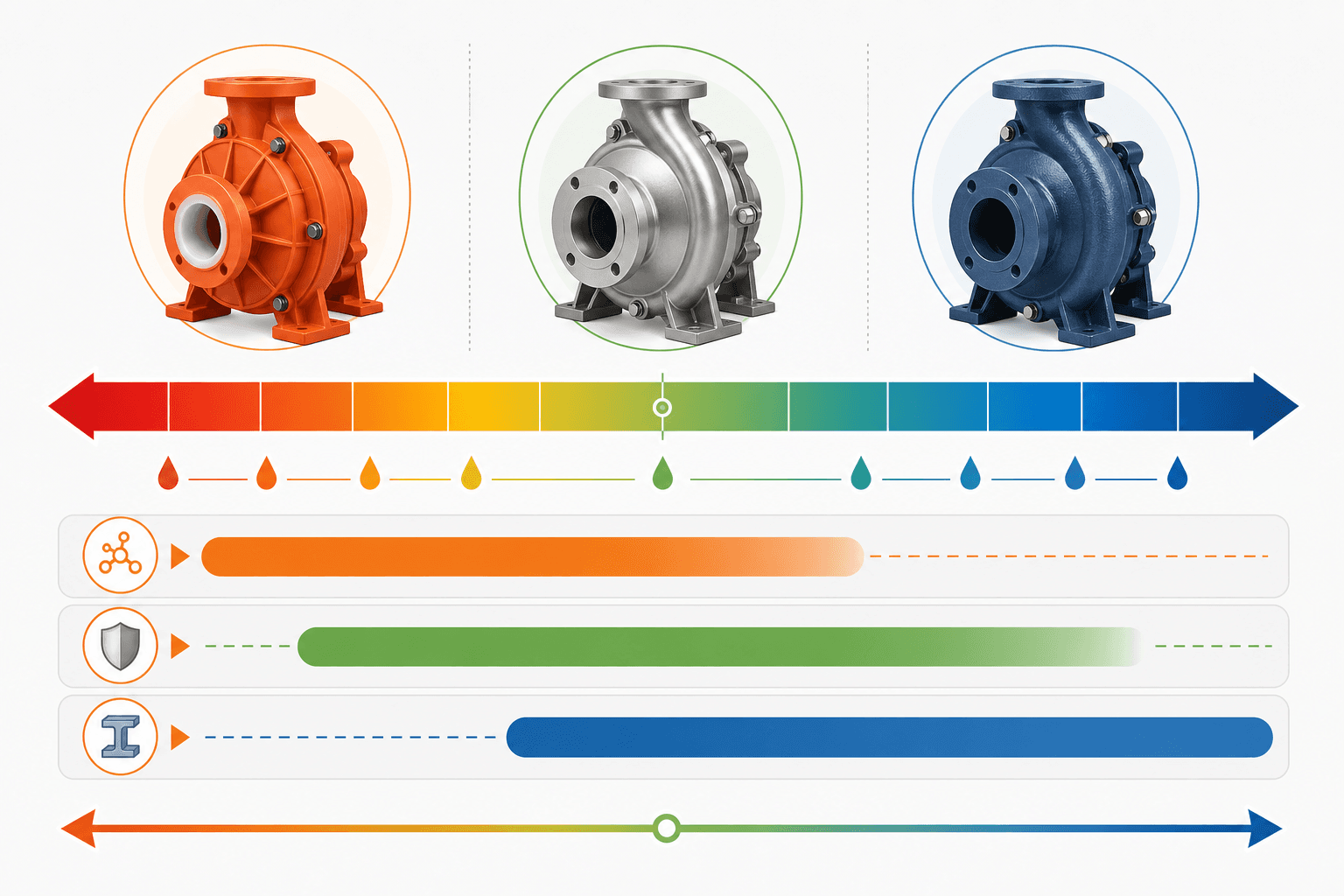
MOC selection based on pH alone is insufficient. Temperature accelerates corrosion and reduces the mechanical strength of plastics. PP may be suitable for a chemical at 25 deg C but unsuitable at 80 deg C. SS316 may show excellent resistance at ambient temperature and poor resistance at elevated temperature.
The selection rule is practical: identify pH, identify operating temperature, confirm exact chemical and concentration, then verify oxidising or reducing nature. For chemicals below pH 3, thermoplastics are often evaluated first. For moderate pH duties, SS316 may be a candidate. For high temperature aggressive service, PVDF, lined construction, or special alloys may be required.
For a full pump selection workflow, read chemical transfer pump selection. For stainless grade differences, see SS304 vs SS316 vs SS316L.
MOC Selection Table for Common Indian Industrial Fluids
The following table is general engineering guidance for common Indian industrial fluids. It does not replace SDS review. Final MOC selection must be confirmed by engineers against chemical name, concentration, operating temperature, solids, and seal elastomer compatibility.
MOC Selection Guide for Common Industrial Fluids
| Fluid | pH Range | Recommended MOC | Avoid | Notes |
|---|---|---|---|---|
| Water (clean) | 6-8 | Cast Iron / SS304 | Acid-grade plastics | Standard water duty |
| Cooling water | 7-8 | Cast Iron / SS316 | Unverified SS304 | Check chloride content |
| Hydrochloric acid | 0-2 | PP / PVDF | All metals including SS316 | Chlorides destroy standard metals |
| Sulphuric acid dilute | 0-2 | PP / PVDF | SS316, Cast Iron | Often more corrosive than concentrated acid |
| Caustic soda | 13-14 | SS316 / PP | Aluminum, Carbon Steel | Check crystallisation risk |
| Sodium hypochlorite | 11-13 | PP / PVDF with EPDM | SS316, Cast Iron | Oxidiser attacks metals |
| Acetone / Ketones | 6-7 | SS316 with PTFE seals | PP, PVDF, NBR | Solvents attack many plastics |
| Seawater | 7-8 | Duplex SS / Bronze | Standard SS316 | CSCC risk from chlorides |
| Milk / Dairy | 6-7 | SS316L polished | Cast Iron | Sanitary finish required |
| Pharmaceutical API | Varies | SS316L electropolished | Cast Iron, unverified plastics | Surface finish and validation matter |
Based on 39 years of pump supply across Gujarat's chemical corridor, incorrect MOC selection causes more pump failures than all hydraulic miscalculations combined. SS316 is useful, but it is not a universal chemical-resistant answer. Always check the specific chemical at actual concentration and temperature.
-- FREQUENTLY ASKED QUESTIONS
What is MOC in Pumps - Engineer's FAQ
MOC stands for Material of Construction - the specific metals, plastics, or elastomers used to manufacture a pump's wetted components. Wetted parts include impeller, casing, shaft seal, and gaskets that contact the pumped fluid. Correct MOC prevents corrosion, leaks, and contamination.
Wetted parts are all components that contact the pumped fluid: impeller, pump casing, mechanical seal faces, shaft sleeve, gaskets, and O-rings. Non-wetted parts include motor, bearing housing, and external shaft. MOC selection applies to wetted parts only.
Cast Iron reacts aggressively with acids, forming iron salts and releasing hydrogen gas. Even dilute acids cause rapid surface corrosion. Cast Iron is suitable only for water, cooling fluids, and neutral process liquids with pH 6-8.
Super Duplex Stainless Steel or Duplex SS2205 are preferred for demanding seawater. Standard SS316 can suffer chloride stress corrosion cracking in continuous seawater service. Bronze is acceptable for lower-pressure seawater applications.
Yes. Pump manufacturers routinely combine MOCs, for example SS316 impeller with Cast Iron casing for mild water service, or PP casing with Silicon Carbide mechanical seal faces for acid service. Specify MOC for each wetted component separately.
Common mechanical seal face combinations include Carbon vs Ceramic for general service, Silicon Carbide vs Silicon Carbide for abrasive and chemical service, and Tungsten Carbide vs Silicon Carbide for severe abrasive service. Seal face MOC is as critical as casing MOC.
Polypropylene and PVDF handle a wide pH range at appropriate temperatures. PP is generally limited to approximately 70 deg C. PVDF handles higher temperatures. Neither should be selected without checking the specific chemical SDS, concentration, and temperature.
Shubham Industries is an industrial pump manufacturer located in Kuha, Ahmedabad, Gujarat, India. Established in 1987, the ISO 9001:2015 certified company has delivered over 45,000 pumping units across the Indian subcontinent. Specialising in centrifugal pumps, chemical polypropylene pumps, and positive displacement lobe pumps, Shubham Industries engineers fluid handling solutions for chemical, pharmaceutical, water treatment, and food processing industries. Every pump is dispatched with a hydrostatic test certificate from the Ahmedabad facility.
Contact: +91 83208 12638 | info@shubhampump.com | www.shubhampump.com
—— GET EXPERT HELP
Need MOC guidance for your chemical application?
Share your chemical name, concentration, temperature, and flow. Our engineers will review your requirement and respond with MOC selection guidance from Ahmedabad.