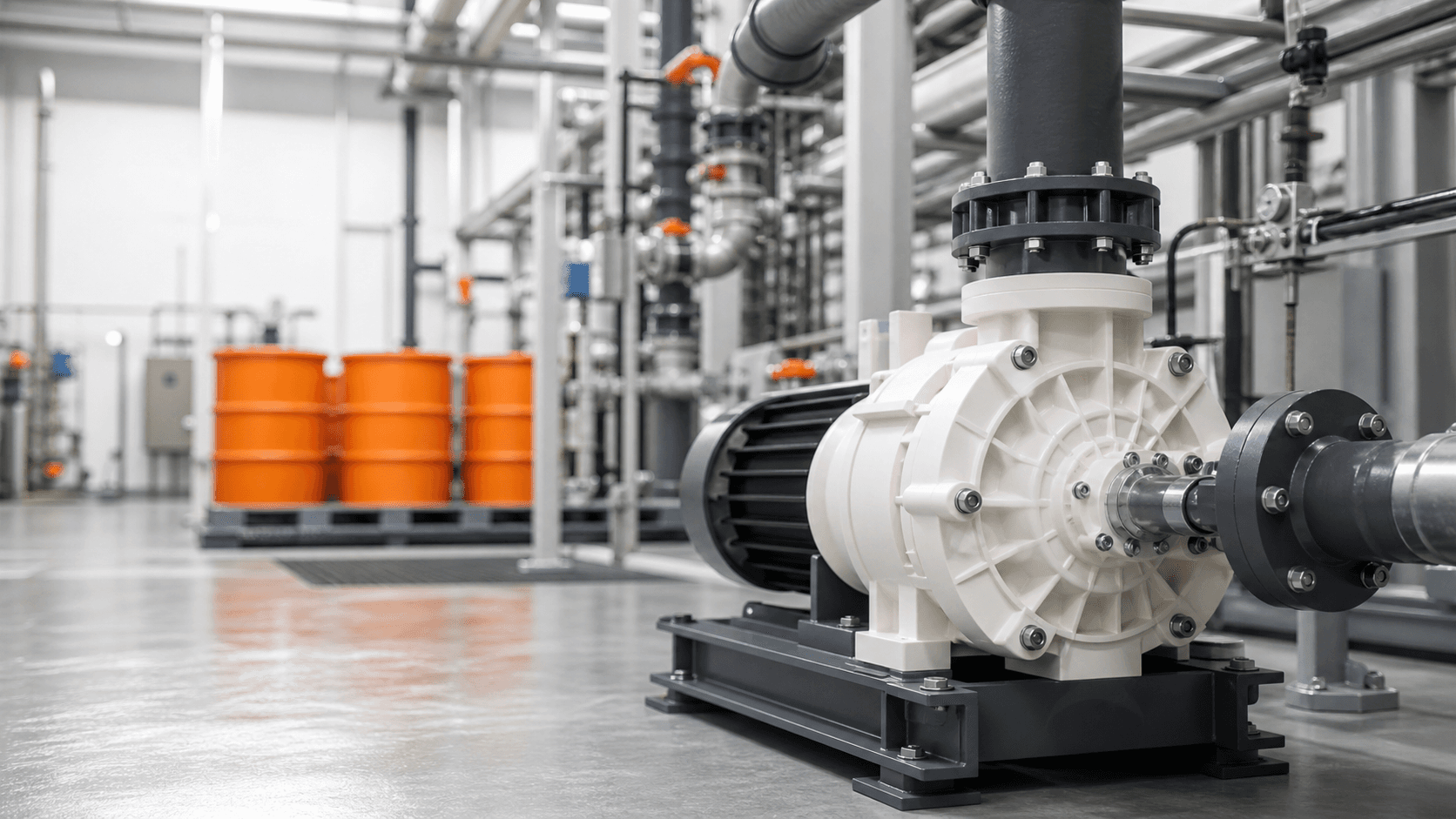
Last Updated: June 2026 - Verified by Shubham Industries Engineering Team
Selecting the right pump for chemical transfer is the single most critical decision in any chemical process plant. Get it wrong and you face corrosion failure, toxic leaks, or motor burnout within months.
At Shubham Industries, Ahmedabad's industrial pump manufacturer since 1987, we have engineered chemical transfer solutions across hundreds of Indian process plants over 39 years. The correct selection comes down to five parameters: fluid viscosity, specific gravity, pH and chemical compatibility, operating temperature, and required flow rate with total dynamic head.
This guide walks through each parameter with exact engineering criteria. Whether you are selecting a CPP Series chemical polypropylene pump for hydrochloric acid, a sealless pump for pharma solvents, or an SCC Series stainless steel centrifugal pump for caustic soda, this guide gives you the engineering framework to select correctly the first time.
Defining Fluid Characteristics: Viscosity and Specific Gravity
The first step in chemical pump selection is precise characterisation of your fluid. Two parameters dominate all others: viscosity and specific gravity. They decide whether a centrifugal pump can operate efficiently, whether the motor has enough power, and whether the selected pump will run near its best efficiency range instead of fighting the system.
Viscosity determines pump type. Water has a viscosity of 1 centipoise (cP) at 20 deg C. Thin acids and solvents fall in the 0.5-3 cP range. Caustic soda solutions reach 5-50 cP depending on concentration. For fluids below 500 cP, a centrifugal pump is the standard choice - efficient, continuous, and cost-effective. Between 500 cP and 5,000 cP, a gear pump or lobe pump becomes necessary as centrifugal efficiency collapses. Above 5,000 cP, only screw pumps or progressive cavity pumps maintain reliable performance.
Specific gravity determines motor size. A centrifugal pump always produces the same head in metres regardless of fluid density. However, heavier fluids require proportionally more horsepower to move. Sulfuric acid at SG 1.84 demands approximately 84% more motor power than water at SG 1.00 for identical flow and head conditions. Undersizing the motor for a heavy chemical is one of the most common and expensive mistakes in chemical plant design.
According to the engineering team at Shubham Industries: "The two most common sizing errors we see from Indian plant engineers are ignoring viscosity correction factors for centrifugal pumps and failing to multiply motor HP by specific gravity. Both lead to either premature pump failure or immediate motor overload."
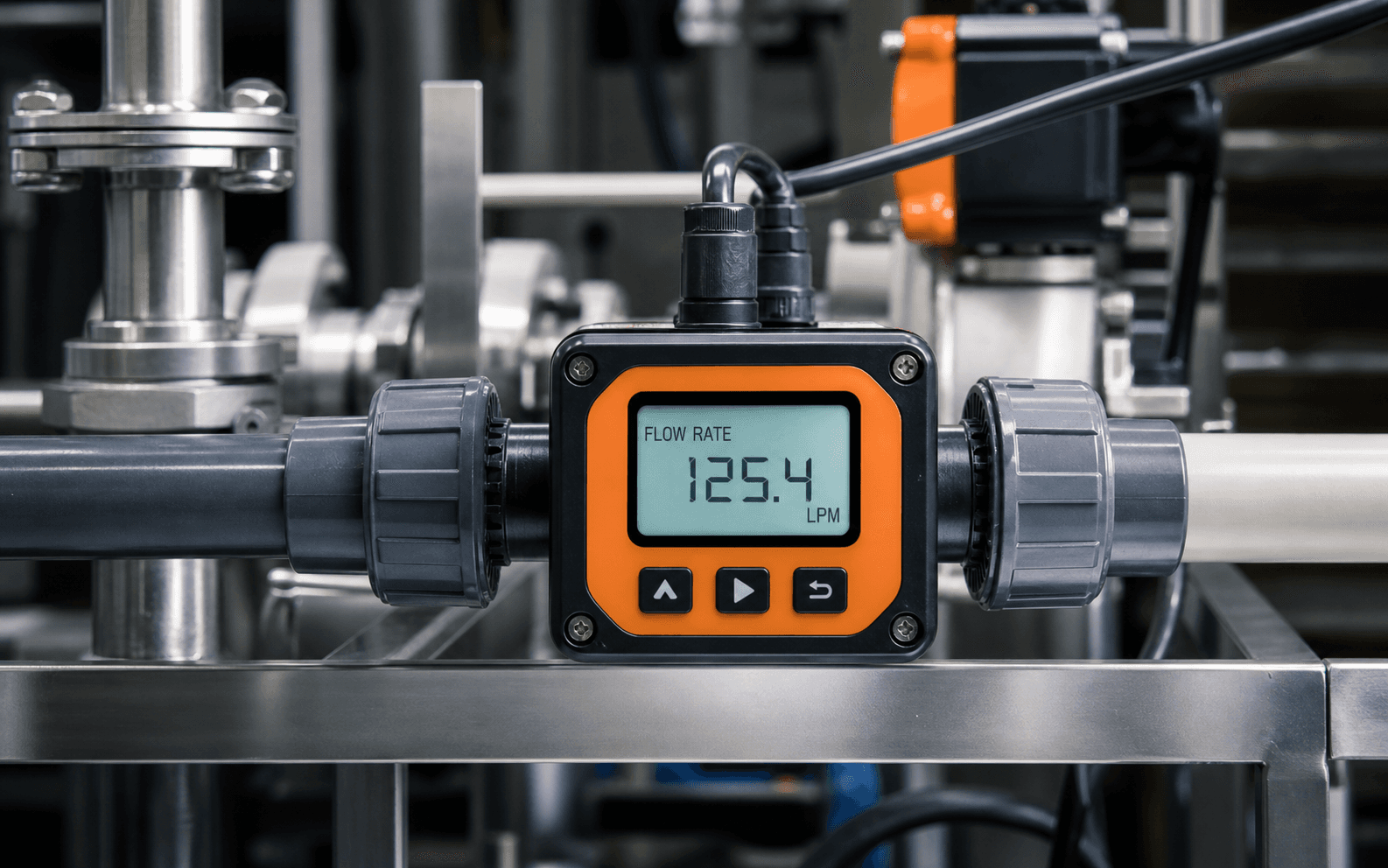
Analysing the Safety Data Sheet (SDS) for Chemical Compatibility
Every chemical used in a process plant has a Safety Data Sheet (SDS) - the most important document in pump selection. The SDS contains the chemical's exact pH, flash point, vapour pressure, specific gravity, and recommended material compatibility data. Do not select the pump from the common chemical name alone; commercial grades vary by concentration, additives, contamination, and temperature.
For pump selection, extract these four values from the SDS:
- pH - dictates primary MOC (material of construction).
- Operating temperature - eliminates thermoplastic options above their safe service range.
- Concentration percentage - determines corrosivity. Note the critical paradox: dilute sulphuric acid is more corrosive to many metals than concentrated H2SO4.
- Oxidising or reducing nature - oxidisers like sodium hypochlorite attack SS316; reducers like hydrochloric acid attack all metals.
Cross-reference the SDS data against a chemical resistance chart for each candidate material: PP, PVDF, SS316, SS304, Cast Iron, and Hastelloy C. A material rated "A" for excellent resistance is required for continuous service. "B" rated materials are acceptable only for intermittent low-temperature service. Never use "C" or "D" rated materials for cost pressure.
Shubham Industries reviews SDS compatibility for every enquiry. Share your chemical name, concentration, and temperature and our engineers will specify the correct MOC before quotation. For a deeper material primer, read what is MOC.

-- QUICK ANSWER
Which pump is best for chemical transfer?
The best pump for chemical transfer depends on the fluid's viscosity, corrosiveness, specific gravity, and temperature. For highly corrosive, low-viscosity fluids like concentrated acids with pH below 3, a sealless magnetic drive pump constructed from PVDF or Polypropylene (PP) provides containment with no dynamic shaft seal and reduced leakage risk compared to mechanical seal designs. For abrasive or highly viscous chemicals above 500 cP, an Air-Operated Double Diaphragm pump in appropriate chemical-resistant elastomers is recommended. For moderate chemicals like caustic soda, dilute acids, and process water, a centrifugal pump in SS316 or PP provides excellent efficiency and reliability. At Shubham Industries, Ahmedabad's industrial pump manufacturer since 1987, we match the exact SDS parameters of your chemical to centrifugal and positive displacement pump series, confirming material compatibility before every quotation across Indian process industries.
Shubham Industries | Kuha, Ahmedabad, Gujarat, India | Est. 1987
Centrifugal vs Magnetic Drive vs AODD Pumps
Three pump technologies dominate chemical transfer. Understanding when to use each eliminates the costliest selection mistakes. The selection is not about which pump is most advanced; it is about which technology matches the chemical, the site risk, and the duty cycle.
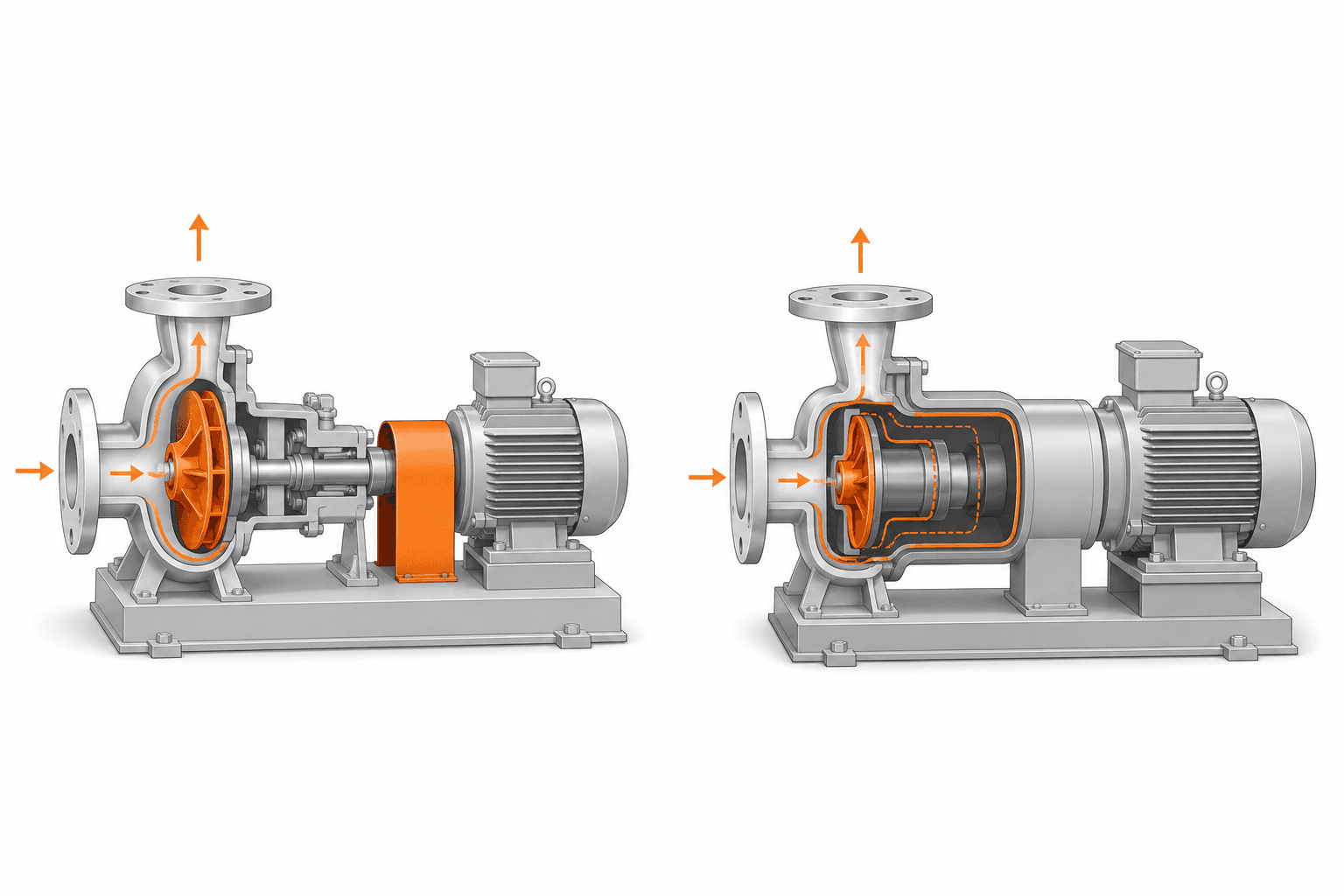
Centrifugal pumps are the workhorse of chemical transfer. They handle continuous, high-volume flow of low-viscosity chemicals efficiently. Their limitation is the mechanical seal - a rotating face seal between pump shaft and atmosphere. For most chemicals this is acceptable. For toxic or volatile chemicals, the mechanical seal introduces a leakage risk that may not be acceptable.
Sealless magnetic drive pumps eliminate the mechanical seal by transmitting torque through a magnetic coupling with no shaft penetration. The result is hermetic containment with no dynamic shaft seal. They are suitable for chlorinated solvents, pharmaceutical APIs, and chemicals where mechanical seal failure risk must be eliminated as a design objective.
AODD pumps, or Air-Operated Double Diaphragm pumps, are the most versatile chemical pump type. They handle abrasive slurries, high-viscosity chemicals, and shear-sensitive fluids. They are self-priming, can run dry without damage, and require no electric motor at the pump location, which can be useful where the site safety standard prefers pneumatic equipment.
Chemical Transfer Pump Technology Comparison
| Parameter | Centrifugal | Magnetic Drive (Sealless) | AODD |
|---|---|---|---|
| Viscosity limit | Up to 500 cP | Up to 100 cP | Up to 50,000 cP |
| Leakage risk | Low with correct mechanical seal | Very low with no shaft seal | Very low with diaphragm |
| Self-priming | No | No | Yes |
| Dry run capability | No - seal damage | No - bearing damage | Yes - no damage |
| Max flow (indicative) | Very high 2200+ LPM | Medium up to 500 LPM | Medium up to 300 LPM |
| Best for | Water, mild chemicals, bulk transfer | Toxic acids, pharma, containment-critical service | Abrasives, slurries, hazardous intermittent transfer |
| MOC options | CI, SS304, SS316, PP | PP, PVDF, PTFE | PP, PVDF, SS316 |
| Relative capital cost | Low | High | Medium |
Flow Rate (LPM) and Total Dynamic Head (TDH) Calculations
After confirming chemical compatibility and pump technology, the system hydraulics must be calculated precisely. Two values define every pump selection: flow rate (Q) in litres per minute (LPM) and total dynamic head (TDH) in metres.
Flow rate comes from production requirement. Add a 10-15% design margin for pipe ageing, fouling, and future capacity. For batch processes, calculate peak instantaneous flow, not average flow. Average flow can hide the actual pump demand and lead to slow batch completion, operator throttling, or undersized transfer lines.
Total Dynamic Head is the sum of four components:
- Static head - vertical elevation difference between suction source and discharge point.
- Friction losses - resistance in pipes, elbows, valves, and fittings.
- Pressure differential - if discharging into a pressurised vessel.
- Velocity head - minor, but included in detailed calculations.
For a typical ground-level tank to elevated process vessel in an Indian chemical plant, TDH commonly ranges from 15-40 metres. For high-rise transfer to reactor vessels, TDH can reach 60-80 metres. Plot required Q and TDH on the pump performance curve. The operating point should fall within 80-110% of the pump's Best Efficiency Point (BEP) for reliable long-term operation. Operating far right of BEP causes cavitation; operating far left causes recirculation and bearing overload.
Based on 39 years of pump installations across Gujarat's chemical corridor, Shubham Industries engineers observe that undersized piping - not undersized pumps - is the most common cause of unmet flow in Indian chemical plants. Always calculate friction losses before finalising pump selection. For quick early-stage screening, use the Pump Selector tool before sharing final process data with an engineer.
-- ENGINEERING ANSWER
How do you calculate NPSHa for a chemical pump system?
NPSHa (Net Positive Suction Head Available) is calculated using: NPSHa = (Patm - Pvap) / (rho g) + Zs - hfs. Patm is atmospheric pressure, Pvap is the fluid's vapour pressure at operating temperature, Zs is the static suction head, positive if tank is above pump and negative if below, and hfs is friction loss in suction piping. Practical example: a pump handling water at 20 deg C at sea level with a suction tank 2 metres above pump and 1 metre of suction friction losses has an NPSHa of approximately 9.8 metres. The same pump handling a solvent at 50 deg C with higher vapour pressure may have an NPSHa of only 4 metres, potentially causing cavitation if the pump's NPSHr is 3.5 metres or higher. Shubham Industries calculates NPSHa for installations as part of standard pump sizing.
Contact the Ahmedabad engineering team before finalising suction piping.
Why Suction Conditions and NPSHa Matter
Net Positive Suction Head Available (NPSHa) is the most overlooked parameter in chemical pump selection - and the most common cause of pump failure after installation. It is often ignored because the discharge side receives more attention: tank height, reactor pressure, and pipe distance. In reality, many chemical pumps fail because the suction side was treated as an afterthought.
NPSHa is the absolute pressure of the chemical at the pump suction inlet in metres. If NPSHa falls below the pump's NPSHr (Net Positive Suction Head Required), the chemical vaporises inside the pump, forming vapour bubbles that implode against the impeller. This process is cavitation, and it erodes metal impellers rapidly while creating noise, vibration, seal damage, and unstable flow.
For chemical transfer, NPSHa is especially critical because:
- High-temperature chemicals have elevated vapour pressures, which subtract directly from NPSHa. A pump at 60 deg C has significantly less NPSHa than the same pump at 20 deg C.
- Long suction lines with multiple elbows and valves create friction losses that reduce NPSHa, potentially below the manufacturer's NPSHr.
- Chemical plants above 500 m elevation have reduced atmospheric pressure, reducing NPSHa by approximately 1 metre per 900 m of altitude.
Engineering rule at Shubham Industries: NPSHa must exceed NPSHr by a minimum of 0.5-1.0 metre for water-like chemicals, and 1.5-2.0 metres for volatile chemicals with vapour pressures above 0.5 bar at operating temperature. Always provide suction tank elevation, liquid temperature, suction pipe length and diameter, and number of fittings when requesting pump sizing.
Based on 39 years of pump installations across Gujarat's chemical and pharmaceutical corridors, the most preventable cause of chemical pump failure is incorrect MOC selection. Plant engineers frequently specify SS316 for applications requiring thermoplastic - either due to cost pressure or insufficient SDS analysis. The result is chloride stress corrosion cracking within 3 to 6 months of commissioning. We verify every chemical's SDS before issuing a pump recommendation - no exceptions.
-- FREQUENTLY ASKED QUESTIONS
Chemical Transfer Pump - Engineer's FAQ
Choose pump material based on the chemical's pH, concentration, and operating temperature. For strong acids (pH 0-3) use Polypropylene (PP) or PVDF. For moderate chemicals use SS316. Always cross-reference the chemical's Safety Data Sheet (SDS) with a material compatibility chart. Shubham Industries reviews MOC suitability for all chemical applications before quotation.
Use a sealless magnetic drive pump when handling toxic, carcinogenic, or highly volatile chemicals where containment with no dynamic shaft seal is required. This technology is suitable for HCl, chlorinated solvents, and pharmaceutical APIs where mechanical seal failure risk must be eliminated as a design objective.
Standard centrifugal pumps handle fluids up to 500-600 cP effectively. Beyond 600 cP, efficiency drops and a positive displacement pump becomes necessary. Shubham Industries SCC series centrifugal pumps are rated up to 1500 cP with reduced efficiency, beyond which our positive displacement series is recommended.
Specific gravity directly multiplies required motor horsepower. A pump moving sulfuric acid (SG 1.84) requires approximately 84% more horsepower than moving water (SG 1.0) at identical flow and head. Always recalculate motor HP when switching to any chemical with SG above 1.1.
No. SS316 fails rapidly in hydrochloric acid and high-chloride environments due to chloride stress corrosion cracking. SS316 performs well with caustic soda, dilute alkalis, and many organic chemicals. Always verify SS316 compatibility against your specific chemical, concentration, and temperature before specifying.
For sodium hypochlorite transfer, use PP or PVDF centrifugal pump with EPDM elastomers. Avoid SS316 and all metals as hypochlorite aggressively attacks stainless steel. Specify a pump rated for oxidising chemicals with a vented seal chamber for safe chlorine gas off-gassing.
Centrifugal pumps deliver continuous high-volume flow for low-viscosity chemicals. AODD pumps handle abrasive slurries, high-viscosity chemicals, and hazardous areas where pneumatic operation is appropriate. AODD pumps are self-priming and can run dry without damage - suitable for difficult, intermittent, or hazardous chemical transfer.
Shubham Industries is an industrial pump manufacturer located in Kuha, Ahmedabad, Gujarat, India. Established in 1987, the ISO 9001:2015 certified company has delivered over 45,000 pumping units across the Indian subcontinent. Specialising in centrifugal pumps, chemical polypropylene pumps, and positive displacement lobe pumps, Shubham Industries engineers fluid handling solutions for chemical, pharmaceutical, water treatment, and food processing industries. Every pump is dispatched with a hydrostatic test certificate from the Ahmedabad facility.
Contact: +91 83208 12638 | info@shubhampump.com | www.shubhampump.com
—— GET EXPERT HELP
Not sure which pump fits your application?
Share your fluid viscosity, flow rate, and application details. Our engineers will review your requirement and respond with pump selection guidance from Ahmedabad.