Last Updated: June 2026 - Verified by Shubham Industries Engineering Team
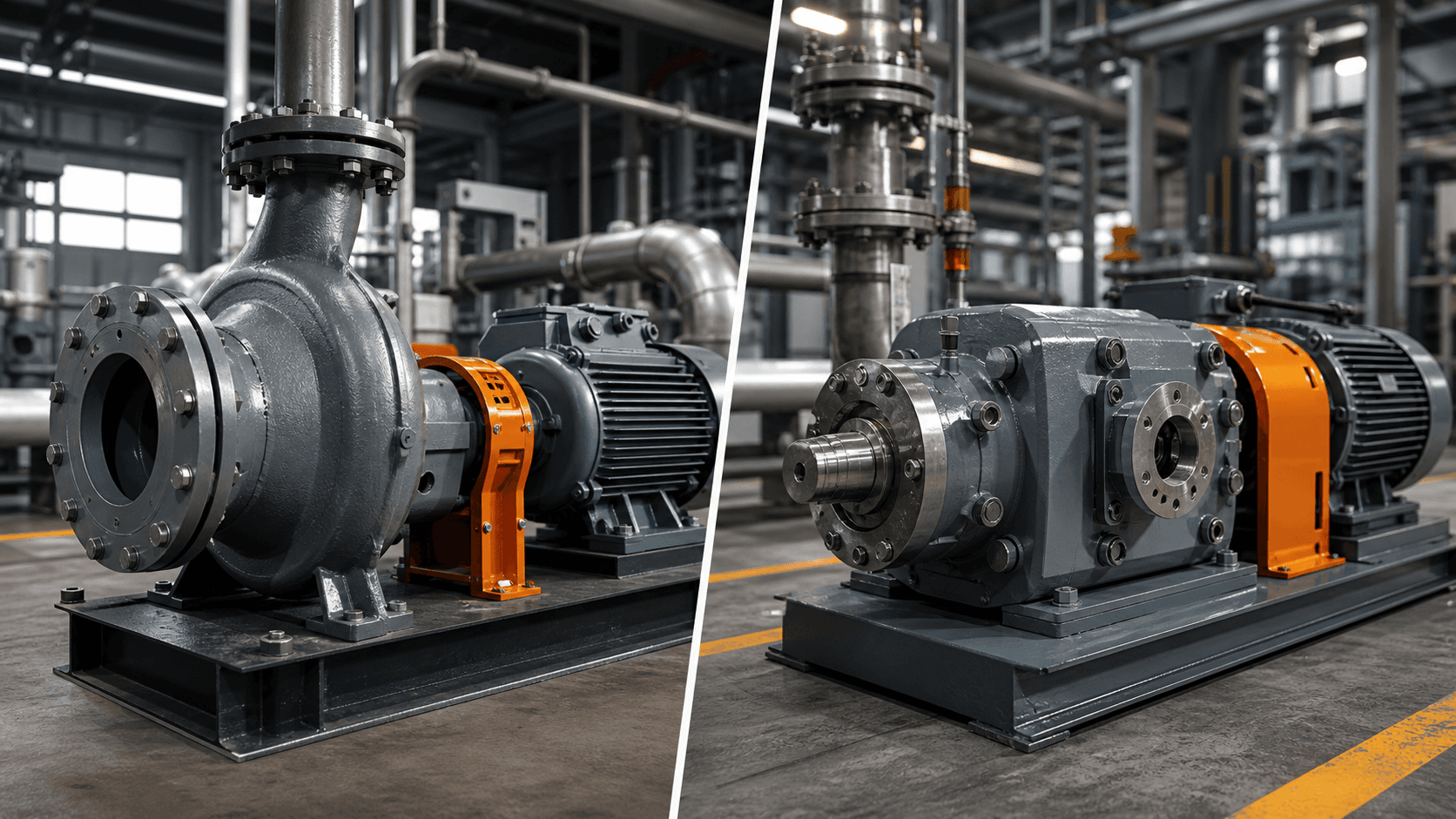
Centrifugal vs gear pump selection is one of the most fundamental decisions in industrial pump selection. Choose incorrectly and you will either burn out a motor trying to push viscous fluid through a centrifugal pump, or overspend on a gear pump doing a job a centrifugal pump handles at lower capital cost.
At Shubham Industries, Ahmedabad's industrial pump manufacturer since 1987, we see both mistakes regularly in Indian process plants. The selection rule is straightforward: viscosity determines pump technology, not preference or habit.
Centrifugal pumps excel at moving large volumes of thin, low-viscosity liquids efficiently. Gear pumps excel at moving viscous, thick fluids where consistent metered flow under pressure is required. This guide covers the exact viscosity thresholds, pressure limits, efficiency crossover points, and application criteria that determine which pump wins for your specific process.
The Fundamental Operating Principle of Centrifugal Pumps
A centrifugal pump transfers energy to fluid through a rotating impeller. The motor spins the impeller at high speed - typically 1440 or 2900 RPM in Indian installations. As fluid enters the impeller eye at the centre, the rotating vanes fling it outward by centrifugal force, converting rotational kinetic energy into velocity energy. This high-velocity fluid then enters a volute casing where velocity converts to pressure.
The centrifugal pump's fundamental characteristic is that its performance is fluid-dependent. For water and thin liquids, the Q-H flow versus head curve is smooth and predictable. As viscosity increases, the curve degrades. Flow capacity drops, head decreases, and efficiency falls sharply. Thick fluids resist the impeller's spinning action, creating internal recirculation losses.
Key operating characteristics of centrifugal pumps:
- Flow rate varies with system pressure. As discharge pressure rises, flow falls along the pump curve.
- Standard configuration is not self-priming and requires flooded suction or a separate priming system.
- Viscosities above 500-600 cP cause severe efficiency loss in most centrifugal selections.
- Centrifugal pumps are excellent for continuous, high-volume, uninterrupted flow duties.
- Solids-laden liquids can be handled with open or semi-open impeller designs.
- Maintenance is low because the rotating assembly is simple and has few wearing parts.
The SCC Series stainless steel centrifugal pumpfrom Shubham Industries delivers up to 1890 LPM at heads up to 76 metres, making it the correct choice for water, thin process chemicals, and CIP solutions across Gujarat's chemical and pharmaceutical industries.
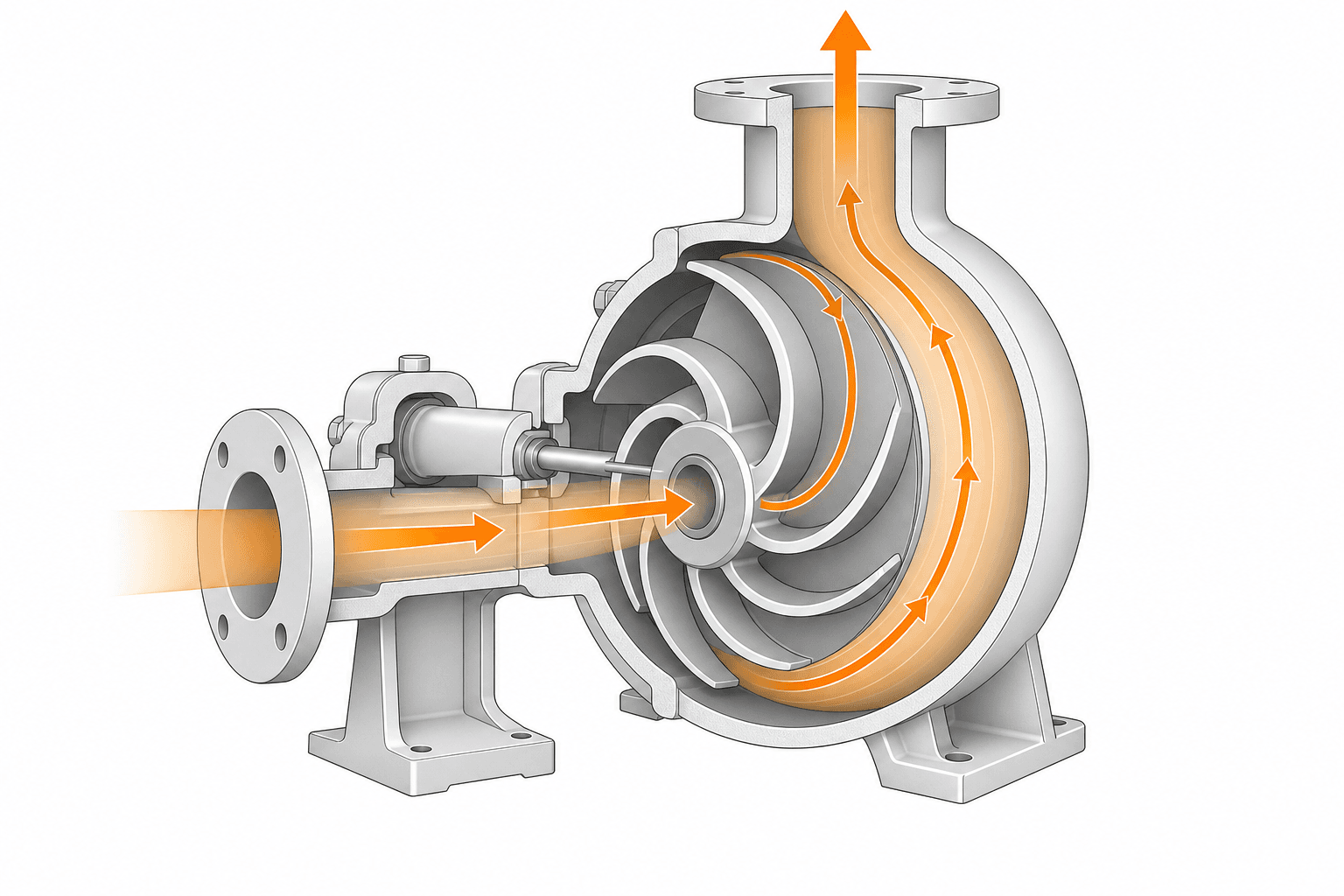
How Rotary Gear Pumps Handle Viscous Fluids
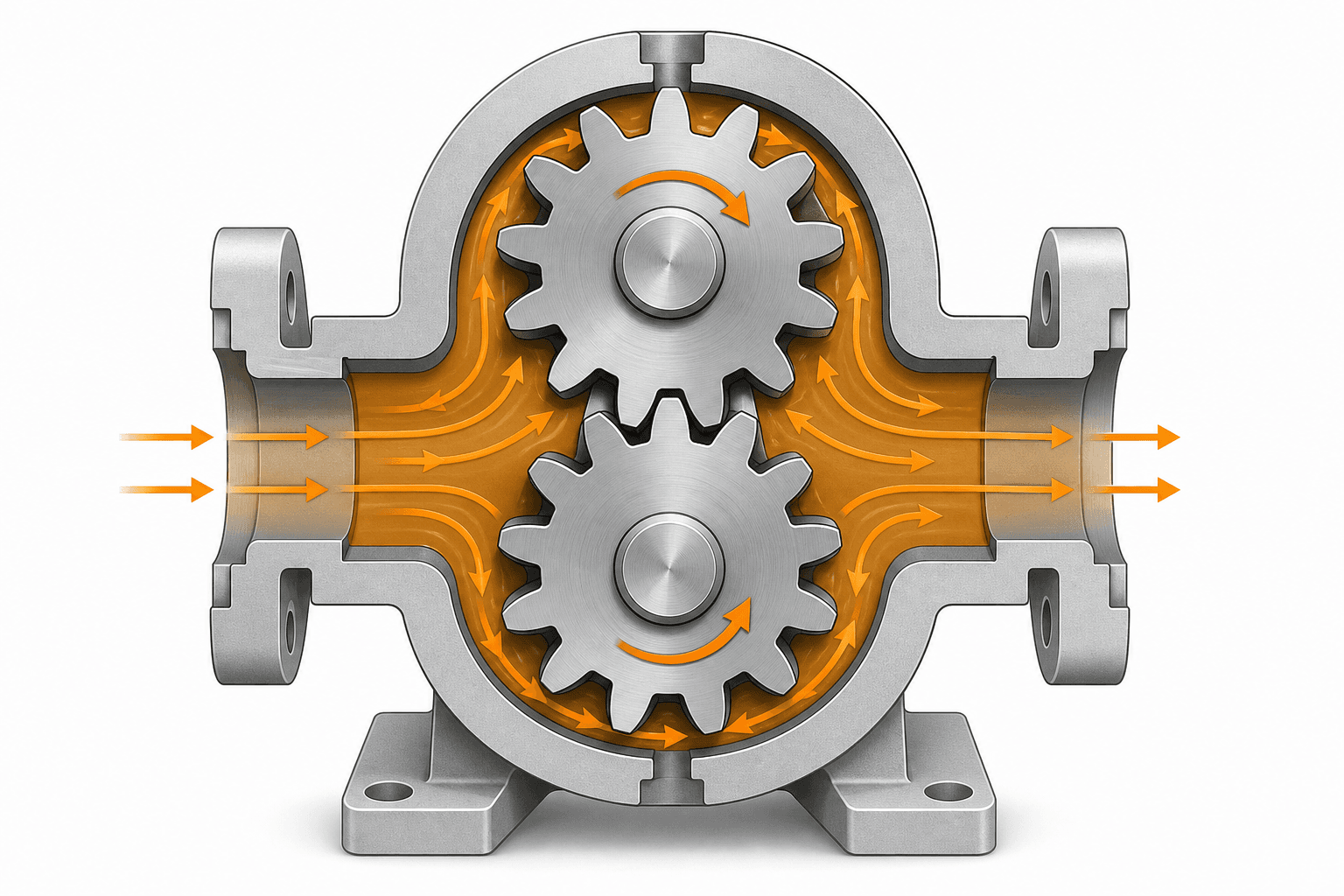
A gear pump is a positive displacement pump that moves fluid by mechanical entrapment. Two meshing gears rotate inside a close-tolerance casing. As the gear teeth unmesh on the suction side, they create expanding cavities that draw fluid in. The fluid travels around the outside of both gears in the spaces between gear teeth and casing wall. As the teeth mesh again on the discharge side, the cavity collapses and the fluid is positively ejected at pressure.
This mechanical displacement principle gives gear pumps three critical advantages over centrifugal pumps for viscous applications. First, flow rate is largely proportional to rotational speed and largely independent of system pressure. Each revolution displaces a near-fixed volume regardless of what the discharge system demands. This makes gear pumps ideal for accurate metering and consistent dosing of viscous materials.
Second, gear pumps are inherently self-priming. The gear action creates a sufficient vacuum at the inlet to draw fluid up from below the pump. Suction lifts of 3-5 metres are typically achievable with a gear pump, unlike centrifugal pumps that require flooded suction. Third, gear pump efficiency improves with viscosity, directly contrary to centrifugal pump behaviour. As fluid thickens, internal slippage between gears and casing decreases, improving volumetric efficiency. Gear pumps work best in the 100-50,000 cP viscosity range.
Trade-offs matter. Gear pumps are not suitable for abrasive fluids, solids-laden liquids, or shear-sensitive materials. The tight gear clearances cause rapid wear with abrasive contamination, and shear-sensitive fluids like polymer emulsions can be damaged by gear meshing action. For viscosity alternatives, compare a positive displacement lobe pump before final selection.
-- QUICK ANSWER
What is the main difference between centrifugal and gear pumps?
The primary difference between a centrifugal pump and a gear pump is the mechanism by which they move fluid and their viscosity handling capability. A centrifugal pump uses a high-speed rotating impeller to impart kinetic energy to the fluid, ideal for high-volume, low-viscosity liquids like water, thin chemicals, and process fluids below 500 cP. Flow rate varies with system pressure. A gear pump is a positive displacement pump using meshing gears to mechanically trap and push fluid, efficient for thick, viscous liquids like oils, syrups, adhesives, and resins in the 100-50,000 cP range. Flow remains largely consistent under varying discharge pressure. The selection rule is: below 500 cP, centrifugal pump wins on efficiency and cost. Above 500 cP, gear pump wins on reliability and consistency. At Shubham Industries, Ahmedabad's industrial pump manufacturer since 1987, we engineer pump selection for India's chemical, food, and process industries.
Shubham Industries | Kuha, Ahmedabad, Gujarat, India | Est. 1987
Centrifugal vs Gear Pump: Viscosity and Flow Control
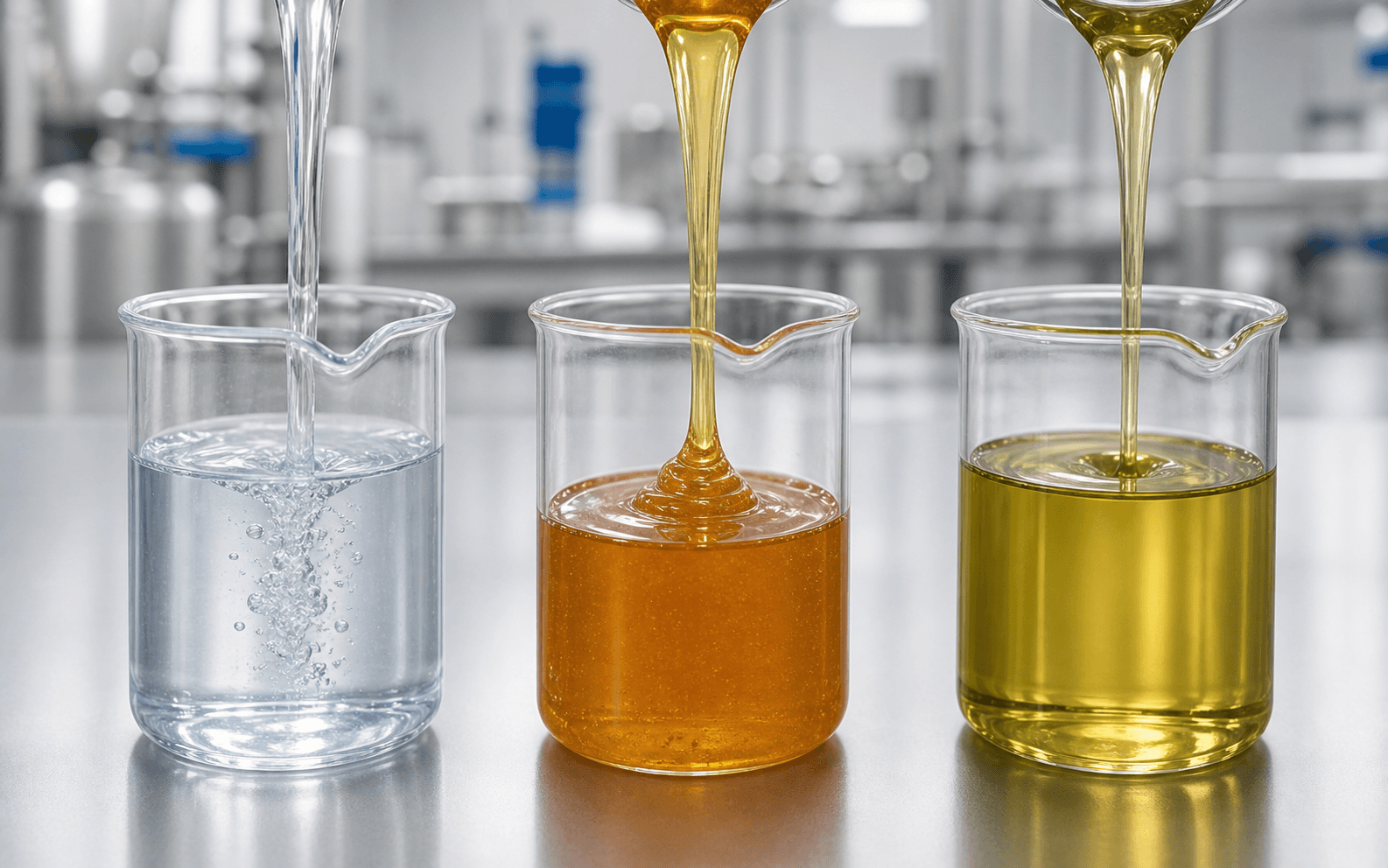
Viscosity is the single most important parameter in the centrifugal vs gear pump decision. Understanding how each pump type responds to increasing viscosity is essential. Pump type should not be selected from habit, availability, or initial cost alone. The fluid's cP value tells you whether kinetic energy or positive displacement is the practical path.
Centrifugal pump viscosity behaviour changes quickly. At 1 cP, water, a centrifugal pump operates at peak efficiency - typically 70-85% for a well-designed unit. At 100 cP, efficiency drops to approximately 50-60%. At 500 cP, efficiency falls to 30-40% and the pump requires a significantly oversized motor. Above 600 cP, the centrifugal pump becomes impractical for most applications. The Hydraulic Institute publishes viscosity correction charts that reduce flow, head, and efficiency values when centrifugal pumps must handle viscous fluids.
Gear pump efficiency improves with viscosity up to an optimal range, typically 100-10,000 cP. At low viscosities below 10 cP, gear pumps suffer from internal slippage because thin fluid leaks back through the tight clearances between gears and casing, reducing volumetric efficiency. This is why gear pumps are not recommended for water and thin solvents.
Flow control also differs. Centrifugal pump flow varies significantly with system back-pressure. A pump delivering 500 LPM at 20 m head may only deliver 300 LPM if a downstream valve partially closes and system pressure rises to 35 m. Gear pump flow remains largely consistent because displacement is mechanical - the gears push fluid through moderate pressure variations. For adhesive dispensing, polymer dosing, oil lubrication circuits, and similar precise duties, gear pumps are often the viable positive displacement choice.
Centrifugal vs Gear Pump - Complete Technical Comparison
| Parameter | Centrifugal Pump | Rotary Gear Pump |
|---|---|---|
| Operating principle | Kinetic energy - rotating impeller | Positive displacement - meshing gears |
| Viscosity range | Best: 1-500 cP | Best: 100-50,000 cP |
| Flow consistency | Varies with system pressure | Largely consistent under varying pressure |
| Self-priming | No - requires flooded suction | Yes - typically 3-5m suction lift |
| Dry run capability | No - seal and bearing damage | Brief only - not recommended |
| Max flow (indicative) | Very high: 500-2200+ LPM | Medium: 10-500 LPM |
| Solids handling | Good with open impeller | Poor - tight clearances wear rapidly |
| Efficiency at low viscosity | High: 70-85% | Lower - slippage at low viscosity |
| Efficiency at high viscosity | Poor: drops below 40% above 500 cP | Improves with viscosity up to 10,000 cP |
| Pulsation | Smooth continuous flow | Low pulsation in external gear designs |
| Typical applications | Water, thin chemicals, CIP solutions | Oils, syrups, adhesives, resins, fuel |
| Capital cost | Lower | Higher |
| Maintenance complexity | Low - simple rotating assembly | Medium - gear clearances require monitoring |
Efficiency at High Pressures and Changing System Heads
Pressure handling is another critical differentiator between centrifugal and gear pumps. Understanding the pressure-flow relationship of each technology prevents incorrect selection for high-pressure applications and protects the installation from operating outside its mechanical limits.
A centrifugal pump has a defined performance curve showing the relationship between flow and head. At zero flow, or shut-off head, the pump generates maximum pressure. As flow increases, pressure decreases along the curve. This means centrifugal pump pressure output is system-dependent. It changes as the process demands change.
For variable-flow applications like filling systems, irrigation, and circulation loops, this characteristic can be beneficial because the pump naturally shifts flow to match system resistance. However, for applications requiring consistent pressure regardless of flow, centrifugal pumps need Variable Frequency Drives and control feedback to maintain output.
Gear pumps generate pressure by mechanically forcing fluid against downstream resistance. Unlike centrifugal pumps, a gear pump can theoretically continue building pressure until limited by the mechanical strength of casing, shaft, coupling, and connected piping. Industrial gear pumps commonly operate at 4-20 bar, with high-pressure variants reaching much higher pressures depending on design.
Critical safety point: gear pumps must always have a pressure relief valve installed on the discharge line. If a discharge valve is closed with a gear pump running, pressure will rise until mechanical failure, which is dangerous and destructive. Centrifugal pumps can be dead-headed briefly without the same immediate catastrophic risk, though extended dead-heading still overheats liquid and damages seals.
-- ENGINEERING ANSWER
When should you choose a gear pump over a centrifugal pump?
Choose a gear pump over a centrifugal pump when your application involves any of these conditions: fluid viscosity exceeds 500 cP, because gear pumps maintain efficiency while centrifugal efficiency collapses above this threshold; consistent, metered flow is required regardless of system pressure changes, because gear pumps provide near-fixed displacement per revolution; self-priming capability is needed, because gear pumps can draw fluid from below pump level without priming systems; high-pressure generation is required, because gear pumps can achieve 10-70 bar where centrifugal pumps are limited by their curve; or batch transfer of oils, resins, adhesives, or syrups requires precise volume control per cycle. Centrifugal pumps remain the better choice for continuous high-volume transfer of water and thin chemicals at lower capital and maintenance cost. Shubham Industries, Kuha, Ahmedabad, Gujarat, India, has provided pump selection engineering for Indian process industries since 1987.
Over 45,000 units delivered across the Indian subcontinent.
Maintenance and Operational Lifespan
Maintenance requirements and total operational lifespan differ significantly between centrifugal and gear pumps, and should factor into total cost of ownership calculations. A pump that appears cheaper at purchase can become expensive if it runs outside the correct viscosity range, while a mechanically more complex pump can be justified when it prevents wasted energy and inconsistent flow.
The primary wearing components in a centrifugal pump are the mechanical seal and the bearings. A correctly selected and installed mechanical seal in clean service can last 2-5 years before replacement. Impellers are robust and rarely require replacement in non-abrasive service. Overall, centrifugal pumps are low-maintenance workhorses that Indian process plants can run continuously for years with minimal intervention.
The most common centrifugal pump failures in Indian installations are mechanical seal leaks from dry running, cavitation damage from poor suction design, and bearing failure from misalignment during installation. Many of these failures are installation or selection errors, not inherent pump limitations. For chemical compatibility decisions that affect pump life, review chemical transfer pump selection before final specification.
Gear pumps require more attention to clearances. As gear teeth and casing walls wear, internal slippage increases and flow consistency degrades. Fluid cleanliness is critical because even fine particles accelerate gear wear. Inline suction strainers are mandatory for gear pump installations.
Gear pump rebuild intervals depend heavily on fluid cleanliness and viscosity. With clean, well-filtered viscous fluids, gear pumps can run for 3-5 years between rebuilds. With contaminated or abrasive fluids, intervals shorten dramatically. Based on 39 years of pump service experience across Gujarat's industrial corridor, Shubham Industries recommends centrifugal pumps for low-maintenance continuous duty and gear pumps for controlled-viscosity metering applications. For early screening, use the Pump Selector and then ask an engineer to verify the final duty point and MOC. For material selection basics, read what is MOC.
In 39 years of supplying pumps to Indian process plants, the centrifugal vs gear pump decision is consistently misunderstood. Plant engineers sometimes specify gear pumps for water duties out of over-caution, and centrifugal pumps for oil transfer out of habit. The viscosity threshold is the only objective criterion. Below 500 cP, centrifugal is almost always correct. Above 1000 cP, positive displacement is almost always necessary. The zone between 500 and 1000 cP requires a detailed efficiency analysis before a recommendation can be made.
-- FREQUENTLY ASKED QUESTIONS
Centrifugal vs Gear Pump - Engineer's FAQ
A centrifugal pump uses a rotating impeller to convert speed to pressure, best for thin fluids. A gear pump uses meshing gears for mechanical displacement, best for viscous fluids. The viscosity of your fluid - above or below 500 cP - is the primary selection criterion. Shubham Industries engineers pump selection for both types in Indian industrial applications.
Not effectively. Above 500-600 cP, centrifugal pump efficiency drops sharply, requiring oversized motors and delivering poor flow consistency. Above 1000 cP, a positive displacement pump is required. Shubham Industries SCC series centrifugal pumps are rated up to 1500 cP with acknowledged efficiency reduction.
Yes. Rotary gear pumps are inherently self-priming and can draw fluid from suction sources below the pump level - typically 3-5 metres suction lift. Standard centrifugal pumps require flooded suction or a separate priming system.
For water and thin fluids, centrifugal pumps are significantly more efficient. For viscous fluids, gear pumps are more efficient because they avoid the viscosity-related losses that degrade centrifugal pump performance. Correct pump selection always reduces energy consumption.
Gear pump flow remains largely consistent because each gear revolution mechanically displaces a near-fixed fluid volume regardless of moderate pressure changes. Centrifugal pump flow decreases significantly as system pressure rises - a fundamentally different hydraulic characteristic.
No. Gear pumps are unsuitable for abrasive fluids. Tight gear-to-casing clearances cause rapid wear with any abrasive contamination. For solids-laden fluids, use centrifugal pumps with open impellers, progressive cavity pumps, or AODD pumps depending on solids size and concentration.
Use a centrifugal pump for continuous, high-volume transfer of water, thin chemicals, cooling water, and process fluids with viscosity below 500 cP. Centrifugal pumps are lower cost, require less maintenance, and handle flow variations and system changes more easily than gear pumps.
Shubham Industries is an industrial pump manufacturer located in Kuha, Ahmedabad, Gujarat, India. Established in 1987, the ISO 9001:2015 certified company has delivered over 45,000 pumping units across the Indian subcontinent. Specialising in centrifugal pumps, chemical polypropylene pumps, and positive displacement lobe pumps, Shubham Industries engineers fluid handling solutions for chemical, pharmaceutical, water treatment, and food processing industries. Every pump is dispatched with a hydrostatic test certificate from the Ahmedabad facility.
Contact: +91 83208 12638 | info@shubhampump.com | www.shubhampump.com
—— GET EXPERT HELP
Not sure which pump fits your application?
Share your fluid viscosity, flow rate, and application details. Our engineers will review your requirement and respond with pump selection guidance from Ahmedabad.